The annual climax of the Viennese cultural calendar can only
be Festwochen; the Austrian capital’s
culture festival held this year between 12th May-18th
June. Established in the 1950s, Wiener
Festwochen remarks on its website,
‘[it was/is] necessary to reconnect with the world, to integrate the city and
the country into the international discourse of art and culture, to promote
life, openness, and the idea of a future’. Events span theatre, dance,
art-installations, music and lectures; celebrating individuals at the forefront
of socio-political activism, avant-garde artistry and intellectual thinking. The festival is heavily subsidised by the Austrian
government and though many of the events are ticketed roughly between €10- €65,
a reasonable amount of the events that take place over Festwochen were free- including those by postcolonial celebrity Gayatri
Chakravorty Spivak, Hegelian-Marxist and movie-pundit Slavoj Žižek and Fannie
Sosa’s sex-positive Feminist ‘twerkshop’. A premium cultural smorgasbord.
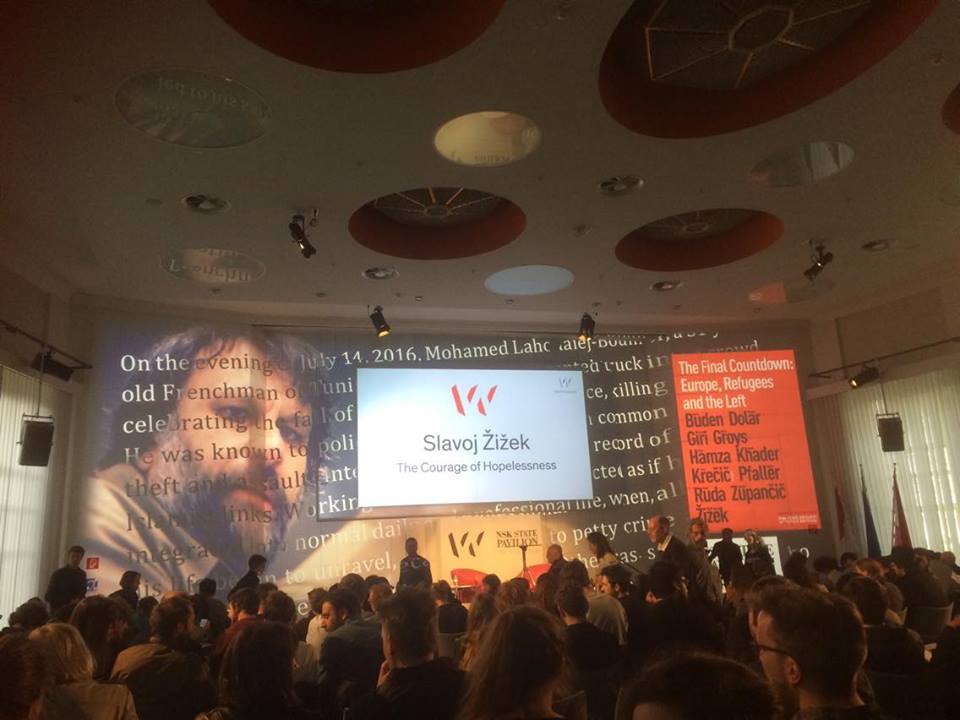
It was as part of ‘The Academy of Unlearning’ lecture series
that Slavoj Žižek’s lecture on ‘The Courage of Hopelessness’ was positioned; a
collection of lectures touching on Western democracy, social dislocation and
the European migrant crisis- encouraging participants to tap into a system of
re-education and critique individual boundaries of understanding.
As an intellectual who is perhaps both admired and lambasted
in equal measures by contemporary medias, Slavoj Žižek has an unshakable cult status
amongst memes junkies and uni-educated white Corbynites alike. The Ed Sheeran
of the hard-Left if you will; Žižek fronts a shy-boy scruffy exterior that
downplays ‘intellectual genius’, idolised by his adoring disciples. Žižek’s writings on Ideology, Psychoanalysis
and Film Theory- famously popularised for the mass-market in films The Pervert’s Guide to Cinema (2006) and
The Pervert’s Guide to Ideology (2012)
cemented him as the poster-boy for Hegelian-Marxism, prescribing a
transcendental celebrity glow to his characteristic idiosyncrasies and habitual
mannerisms.
Following the publication of ‘The Final Countdown: Europe,
Refugees and the Left’, Žižek’s essay and lecture title derives from the
Italian philosopher Giorgio Agamben claim that “thought is the courage of
hopelessness”. Speaking in the present tense, Žižek underscores the bleakness
of European politics with destructive language, ‘The true courage is to admit
that the light at the end of the tunnel is most likely the headlight of another
train approaching us from the opposite direction’. Exploring this prophetic
collision, he goes on to mark this oncoming threat as the ‘flow of refugees’ or
‘the problem of refugees’ that will certainly ‘explode again’. His central
claim here is (perhaps unsurprisingly) radical, calling for a ‘move away from
the humanitarian’.
‘This fascination with refugees
suffering is the ultimate fetish because it changes a mega serious political
problem into a humanitarian concern, and sentimental liberals always like this,
to change again and avoid critical political analysis and begin to talk this
rubbish of “are our hearts open enough”? [...] We don’t need open hearts we
need precise political action to break this cycle of global geopolitics’
Interrogating the difficulty of multiculturalism, Žižek
points the finger at the ‘the burden of a specific way of life’ and the
ambiguities that surround this ‘way’ as a point of conflict and uncertainty.
Using the Lacanian notion of
‘jouissance’, Žižek consolidates the notion of a ‘way of life’ as ‘not direct
pleasure but the enjoyment of organising pleasure’ culturally organised in such
a way that it ignores cultural attitudes to sexual customs and hierarchy as
values that exist ‘at the very core of a way of life’. Žižek presents the idea
of arranged marriages as a key component to a way of life, citing cultural
conflicts within his native Slovenia, as well as looking at the model of the
Indian caste system as a way of life that was used to the benefit of British
imperialism, stating that ‘authentic imperialism has always been
multicultural’.
The discourse is dense and pessimistic, focus turning to the
recent French election and the futility of neoliberal politics, ‘Macron
embodies politics that produced Le Pen’ and Žižek asserts despondently; ‘a vote
for Macron is a vote for Le Pen in four years time’.
At one point, Žižek confesses to having streamed the recent
adaptation of Margaret Atwood’s The
Handmaid’s Tale on piratebay (‘I caught myself enjoying it very much, I was
horrified’). Broadening into a Lacanian discussion on the sources of pleasure, Žižek
digresses into an account of rape of which the perpetrator denied being
motivated by carnal desires and was thus considered innocent by the Mexican
authorities. Here, Žižek revisits his trope that ‘of course, feminists
explode’, marking the Left’s obsessive preoccupation with safe-spaces and a
general emotional excess with his argumentation teetering towards the Right.
The attention to detail in describing the account as well as the depiction of
graphic violence in the screened video clip underscores Žižek’s inability to
censor or shelter. This extends to his provocative brand of apathetic humour,
and on a theoretical level in the assertions of his lecture argumentation that
calls for a move away from humanitarianism. Who needs trigger warnings, right?
The proceeding Q&A followed in a very Žižekian manner,
scrutinising the mediation of pre-meditated questions through a host and
reminding the audience to save their clapping for when they are directed,
signposting the conventions of a conference.
The initial question: ‘How did you sleep yesterday?’ is met with
frostiness that exposes Žižek’s personal brand of radical humour through
juvenile hyperbole ‘What is the point of this question? If you put it the way
you have put it, it would be like I have raped five children.’
As he tries to engage in a direct Q&A with audience
members Žižek confesses ‘I feel bad. The best thing would be to- this is
deepest anti-feminist manipulation- have a lady ask the questions so that we
can say that ladies were also- you know.’ Though Žižek does undoubtedly
recognise the extremes of his humour as an alienating factor, what is posed as
a noble intervention for the sake of inclusion is dashed as soon as the
audience member is chosen- an older Austrian man- over the energetically waving
arm of a female audience member. In doing this, Žižek reduces a demonstrative
act to a futile pledge to compensate for his poor taste in humour, further
isolating the voices of Left-wing women within a panel and audience largely
made-up of men. Žižekers hang off their demi-god’s every word, praying for the
next available moment to laugh heartily and declare their commonality.
In sum, I’m a sucker for free culture. Festwochen’s scintillating selection of scholars, exhibitions,
installations and performances had me from the word go, and the accessibility
of free entry is a credit to the Austrian government and Arts funding.
Hey, maybe I am a misguided, hysterical ‘exploding feminist’
but declaring progress to be a move away from empathy is certainly heavy
handed.
written for [smiths] magazine: http://www.smithsmagazine.co.uk/2017/09/04/vienna-festwochen-slavoj-zizek-the-courage-of-hopelessness-at-ak-wien-bildungszentrum-vienna-200517/
Elinor Potts