Tuesday, 30 May 2017

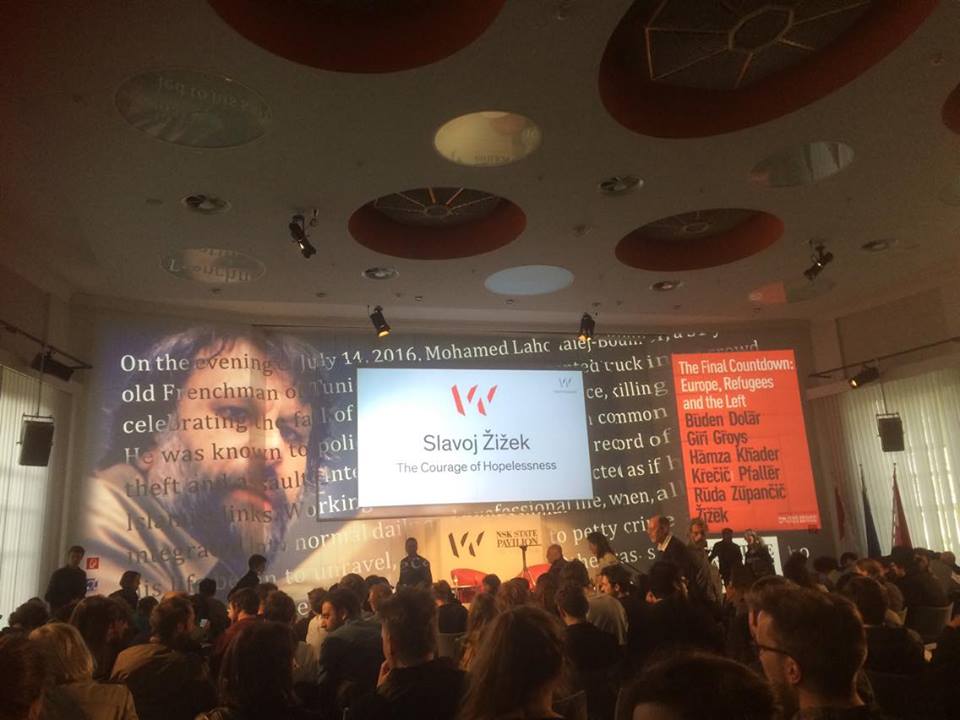
[smiths] magazine: Slavoj Žižek ‘The Courage of Hopelessness’ at AK Wien Bildungszentrum, Vienna. 20/05/17

The annual climax of the Viennese cultural calendar can only be Festwochen; the Austrian capital’s culture festival held this year between 12th May-18th June. Established in the 1950s, Wiener Festwochen remarks on its website, ‘[it was/is] necessary to reconnect with the world, to integrate the city and the country into the international discourse of art and culture, to promote life, openness, and the idea of a future’. Events span theatre, dance, art-installations, music and lectures; celebrating individuals at the forefront of socio-political activism, avant-garde artistry and intellectual thinking. The festival is heavily subsidised by the Austrian government and though many of the events are ticketed roughly between €10- €65, a reasonable amount of the events that take place over Festwochen were free- including those by postcolonial celebrity Gayatri Chakravorty Spivak, Hegelian-Marxist and movie-pundit Slavoj Žižek and Fannie Sosa’s sex-positive Feminist ‘twerkshop’. A premium cultural smorgasbord.
It was as part of ‘The Academy of Unlearning’ lecture series that Slavoj Žižek’s lecture on ‘The Courage of Hopelessness’ was positioned; a collection of lectures touching on Western democracy, social dislocation and the European migrant crisis- encouraging participants to tap into a system of re-education and critique individual boundaries of understanding. 
As an intellectual who is perhaps both admired and lambasted in equal measures by contemporary medias, Slavoj Žižek has an unshakable cult status amongst memes junkies and uni-educated white Corbynites alike. The Ed Sheeran of the hard-Left if you will; Žižek fronts a shy-boy scruffy exterior that downplays ‘intellectual genius’, idolised by his adoring disciples.  Žižek’s writings on Ideology, Psychoanalysis and Film Theory- famously popularised for the mass-market in films The Pervert’s Guide to Cinema (2006) and The Pervert’s Guide to Ideology (2012) cemented him as the poster-boy for Hegelian-Marxism, prescribing a transcendental celebrity glow to his characteristic idiosyncrasies and habitual mannerisms.
Following the publication of ‘The Final Countdown: Europe, Refugees and the Left’, Žižek’s essay and lecture title derives from the Italian philosopher Giorgio Agamben claim that “thought is the courage of hopelessness”. Speaking in the present tense, Žižek underscores the bleakness of European politics with destructive language, ‘The true courage is to admit that the light at the end of the tunnel is most likely the headlight of another train approaching us from the opposite direction’. Exploring this prophetic collision, he goes on to mark this oncoming threat as the ‘flow of refugees’ or ‘the problem of refugees’ that will certainly ‘explode again’. His central claim here is (perhaps unsurprisingly) radical, calling for a ‘move away from the humanitarian’.
‘This fascination with refugees suffering is the ultimate fetish because it changes a mega serious political problem into a humanitarian concern, and sentimental liberals always like this, to change again and avoid critical political analysis and begin to talk this rubbish of “are our hearts open enough”? [...] We don’t need open hearts we need precise political action to break this cycle of global geopolitics’

Interrogating the difficulty of multiculturalism, Žižek points the finger at the ‘the burden of a specific way of life’ and the ambiguities that surround this ‘way’ as a point of conflict and uncertainty. Using the Lacanian  notion of ‘jouissance’, Žižek consolidates the notion of a ‘way of life’ as ‘not direct pleasure but the enjoyment of organising pleasure’ culturally organised in such a way that it ignores cultural attitudes to sexual customs and hierarchy as values that exist ‘at the very core of a way of life’. Žižek presents the idea of arranged marriages as a key component to a way of life, citing cultural conflicts within his native Slovenia, as well as looking at the model of the Indian caste system as a way of life that was used to the benefit of British imperialism, stating that ‘authentic imperialism has always been multicultural’.
The discourse is dense and pessimistic, focus turning to the recent French election and the futility of neoliberal politics, ‘Macron embodies politics that produced Le Pen’ and Žižek asserts despondently; ‘a vote for Macron is a vote for Le Pen in four years time’.
At one point, Žižek confesses to having streamed the recent adaptation of Margaret Atwood’s The Handmaid’s Tale on piratebay (‘I caught myself enjoying it very much, I was horrified’). Broadening into a Lacanian discussion on the sources of pleasure, Žižek digresses into an account of rape of which the perpetrator denied being motivated by carnal desires and was thus considered innocent by the Mexican authorities. Here, Žižek revisits his trope that ‘of course, feminists explode’, marking the Left’s obsessive preoccupation with safe-spaces and a general emotional excess with his argumentation teetering towards the Right. The attention to detail in describing the account as well as the depiction of graphic violence in the screened video clip underscores Žižek’s inability to censor or shelter. This extends to his provocative brand of apathetic humour, and on a theoretical level in the assertions of his lecture argumentation that calls for a move away from humanitarianism. Who needs trigger warnings, right?
The proceeding Q&A followed in a very Žižekian manner, scrutinising the mediation of pre-meditated questions through a host and reminding the audience to save their clapping for when they are directed, signposting the conventions of a conference.  The initial question: ‘How did you sleep yesterday?’ is met with frostiness that exposes Žižek’s personal brand of radical humour through juvenile hyperbole ‘What is the point of this question? If you put it the way you have put it, it would be like I have raped five children.’
As he tries to engage in a direct Q&A with audience members Žižek confesses ‘I feel bad. The best thing would be to- this is deepest anti-feminist manipulation- have a lady ask the questions so that we can say that ladies were also- you know.’ Though Žižek does undoubtedly recognise the extremes of his humour as an alienating factor, what is posed as a noble intervention for the sake of inclusion is dashed as soon as the audience member is chosen- an older Austrian man- over the energetically waving arm of a female audience member. In doing this, Žižek reduces a demonstrative act to a futile pledge to compensate for his poor taste in humour, further isolating the voices of Left-wing women within a panel and audience largely made-up of men. Žižekers hang off their demi-god’s every word, praying for the next available moment to laugh heartily and declare their commonality.
In sum, I’m a sucker for free culture. Festwochen’s scintillating selection of scholars, exhibitions, installations and performances had me from the word go, and the accessibility of free entry is a credit to the Austrian government and Arts funding.
Hey, maybe I am a misguided, hysterical ‘exploding feminist’ but declaring progress to be a move away from empathy is certainly heavy handed.


written for [smiths] magazine: http://www.smithsmagazine.co.uk/2017/09/04/vienna-festwochen-slavoj-zizek-the-courage-of-hopelessness-at-ak-wien-bildungszentrum-vienna-200517/ 

Elinor Potts

Sunday, 21 May 2017

Hinds Band Review for Cool Brother zine


Hinds are a fully-charged female four-piece hailing from Madrid, favoured by the likes of Primal Scream’s Bobby Gillespie. Comprised of Ade, Amber and front-girls, Carlotta and Ana, we’ve seen them escalade in size, strength and following.
It all began two years ago, when 2014 saw Ana and Carlotta release their debut EP, Bamboo. Charming, fun and totally badass, Bamboo is a pared back lo-fi rock ‘n’ roll ditty with a shoe-scuffing call and response to playground pining. They’ve hardly been sitting pretty since. That year, we watched Hinds battle intimate venues like Corsica Studios, while remaining deers in the headlights when it came to interacting with the crowd. Incessantly giggling, dewy-faced and doe-eyed, they were still getting to grips with the English language. In 2015, we were treated to a wealth of gigs, from Hong Kong to Hoxton, and 16 performances at SXSW. Now, they’re headlining Koko, they’re playing Glastonbury two years in a row and they’ve performed along side the likes of The Libertines, The Black Lips and The Strokes.
Yet, despite being on the road more than Kerouac, they still found the time to write and record debut album, Leave Me Alone. Suitably evocative of teenage rebellion, it goes hand-in-hand with their nonchalant attitude. Stand-out tracks include Garden and the toe-tapping Warts; a cautionary tale of a psycho witch, delivered with a playful lure; ‘She acts too crazy/Absurdly wild/Always ready for a winky/She always burns her warts’.
They’ve achieved a lot in two years. Promising an electric and thoroughly vivacious live performance, Hinds are definitely ones to circle in your festival programmes this summer.


Thursday, 30 March 2017

Notes from Vienna

The Erasmus student is a dying breed, and as one of the last years of Goldsmiths exports (NB: they’ve pledged to continue the scheme for the next two years) I shall hereby present to you an account of the first month of life in Vienna which has taken form in roughly 5 non-chronological chapters:

1)      Sprechen Sie Englisch?

Upon receiving confirmation last August that I would be studying in Vienna for my second semester I swiftly downloaded Duolingo and smugly assumed that I was already part-way to learning fluent German. A few weeks of sporadic testing and I could confidently declare that ‘the beetles drink milk’ which made me strongly evaluate the relevance of vocabulary available on Duolingo and so I consequently stopped trying entirely. As a result I now have a purely beetle-based understanding of the German language and am thus finding it somewhat troublesome navigating social situations. Despite being anxious to avoid the stereotype of the Brit abroad as overly reliant on the assumption their host will speak English, I have in no way deviated from this stereotype, thus finding myself in a constant state of self-deprecation, idealistically guessing my way through the entire language with my knowledge of English, Swedish and smiles (the universal tongue).
2           2)      Transition
Comparatively, rent in Vienna is an absolute pinch and close to half of what I had been paying in Deptford so I really shouldn’t be complaining. Unfortunately this has come at the cost of my beloved student-living disarray that seemingly does not extend to Austrian student digs owing to a non-exhaustive list of house rules that I am penalised for failing to abide by.
If I were to describe the lavish architecture of Vienna to a South East Londonder I would liken it to Deptford Town Hall x100. It’s objectively jaw-dropping and a perpetual delight. From the University building itself to parliament, the museum quarter, grandiose theatres and opera houses, strolling around the city is a constant thrill. For those who feel culturally unfulfilled in spite of the intimidating rich cultural backdrop of Vienna, there is an opera themed public toilet in Karlsplatz station that charges you 50 cent to piss to Strauss; an exercise easily achieved in the comfort of your own home for the price of a Spotify premium account.

3           3)      Nose-diving into a life of meat- my passionate affair with a Käsekrainer
Away from the judgements of South-East vegans, I have developed a deeply spiritual connection with the Austrian witching-hour delicacy known as the Käsekrainer or ‘Carniolan sausage’ over the course of this month. For those of you who are unfamiliar with this work of Austro-Hungarian genius, the Carniolan sausage is a dish of true perfection; a pork (?) sausage internally laced with hot cheese between a waistcoat of baguette. But beware: this ambrosial masterpiece is served with a side order of risk, as the visitor’s guide to Vienna advises; ‘if you’re not careful, a sufficiently-distressed Käsekrainer can propel hot fat huge distances, necessitating the wearing of protective goggles.’[1]. For those of you hankering for a sample, there are various restaurants around London that serve the dish, though in much more formal setting. This is a dish best served Wasted.
Asides from national specialities, the discovery of the pay-as-you-wish restaurant Der Wiener Deewan has entrenched meat-eating habits with a delicious selection of all-you-can-eat set curries for whatever price you feel is most fair. This frankly blew the collective minds of me and my culinary companion, opting for a medium sized mains portion and dessert for €6.50 each. My newfound meat-based lifestyle is delicious and I am never turning back.

4          4)      Rebirth/ Running around/Foreign territory
As a response to chapter 3 and with all this abundant spare time that I used to fill with socialising and evenings at the Marquis of Granby I decided to invest my time and physical energy in the preconception of the Erasmus student as self-interested. The transition to healthy-Goth (a reworking of the notion of Health Goth with a diminished emphasis on the aesthetic) has been a tale of two halves; thwarted somewhat by the devilish presence of cheap European cigarettes and bottles of Prosecco at €3 a pop. In the first week I donned my optimistic gym wear and triumphantly announced to my new housemates I was going on a run in a (rehearsed) nonchalant tone, hereby marking my new persona as part-time runner. Leaving the flat I found myself blindly ‘running’ around the local neighbourhood block-by-block, polishing off this athletic venture with a stroll around the local Austrian equivalent of Waitrose, and window shopping for food in sports-gear. I cheerfully imagined the telephone conversations of my flatmates, ‘Our new flatmate’s great, she’s only been here two days and she’s always out running!’. Such painfully unsustainable lies. 
5         5)      Brexit Repentance (BrePentance?)
The legacy of June 23rd is still hot on the tongues of many Austrians when you confess British nationality. Furthermore, having opted for more Cultural Theory based modules at the University of Vienna I am given daily reminders of the brutal history of British colonial imperialism and am plagued by a cloud of generally perpetual guilt. All in all, it’s not a great time to be a Brit abroad and as a some-time bar-dwelling exchange student, you’ll constantly find yourself haplessly apologising on behalf of your country’s idiocy. I’ve taken to wearing my ‘Don’t blame me I voted Remain’ badge regularly to avoid confusion.
I recently attended an event hosted by the university welcoming incoming exchange students that fell on the day that the UK formally began the process of leaving the EU. Speaker Heinz Fassmann (Vice-Rector of International Affairs) asked for a show of hands of UK students and later approached me after the speeches (regrettably directly after I had launched myself at the most handsome buffet I have ever witnessed) asking me- essentially on behalf of all Erasmus departments in the UK, what was going to happen to the scheme moving forward, as 50% of students of the University of Vienna seek an exchange to the UK. What then ensued was a furious rant delivered between mouthfuls of smoked salmon and red wine about the monumental confusion of Brexit and lack of understanding surrounding EU-funded schemes and free movement going forward.  The lethal mixture of Brexit-talk and a free bar left me thoroughly red in the face.

This has been life thus far; a whirlwind few weeks of flustering around in a holiday-mode daze that I’m reluctantly emerging from. Am I integrating? Maybe. I’ve invested in some red slippers emblazoned with ‘Austria: Vienna’ in white stitching so I guess I am part there. Unfortunately I didn’t inspect said slippers thoroughly enough and it turned out that I’d purchased two left shoes. Hopefully this isn’t some horrible metaphor for bumbling through life.


Words by Ellie Potts. 
Written for publication in [smiths] magazine, all rights reserved.

[1] http://www.visitingvienna.com/eatingdrinking/food/kasekrainer/

Monday, 27 February 2017

Mike McCormack in Conversation with Blake Morrison for [smiths] magazine

Ellie Potts gives a detailed account of Goldsmiths Prize winner Mike McCormack's interview with Blake Morrison.

Speaking in the wake of his success, Mike McCormack explored the creative process in crafting his 2016 Goldsmiths Prize winning novel Solar Bones. As an inventive and experimental work, McCormack’s novel surpassed the criteria to ‘open up new possibilities for the novel form’ and as the fourth winner of the prize, McCormack follows in the line of distinguished previous winners including Eimear McBride, Ali Smith, and Kevin Barry.
Being McCormack’s third published novel, he professed his fluctuating successes that eventually bred Solar Bones. McCormack’s first edition of short stories Crow’s Requiem published in 1986 emphatically “divided the world”, receiving what McCormack confessed as the worst review he has ever seen; lamenting the felling of trees for the book’s print and despairingly noting ‘I can think of nothing good to say about this book’. What proceeded was what McCormack describes as “ten years of nothing” following being dropped by his publisher after the publication of Notes from a Coma. To Morrison however, the arresting opening of Solar Bones was what set the novel apart from others on the shortlist, highlighting the vivid depiction of a deconstructed tractor that marks the protagonist Marcus Conway’s fascination with the fragility of the universe and the process of disassembling.
As a novel written in a single sentence, McCormack was keen to shy away from the labels of stream of consciousness narrative, marking the continuous fluidity between thoughts of the ghostly narration that fails to lapse. In spite of McCormack’s absence of grammatical punctuation, he utilises white space as a means of punctuating and describes the novel as “easiest understood as an Aria”. Whilst radical in form, McCormack blends an amalgamation of high and low brow culture, making biblical allusions alongside reference to Radiohead albums that he declared as following in the tradition of Thomas Pynchon; the “giver of license to low comedy”.
Through McCormack’s brief experience having trained as an engineer, he foregrounds the importance of working characters to stimulate “pulse and routine”. “Engineers build the world” he declared, “they facilitate every moment, this lecture hall is conceived through an engineer”. As a graduate of English and Philosophy from the University of Galway, McCormack also commended the influence of artists and creatives on his craft that manifests in the novel through Marcus’ artist daughter. The fragmentation of form and dispersion of words across the page within Solar Bones is therefore indebted to the influence of McCormack’s artistic tradition and the visual aesthetic of paragraphs that tend to “stand and stare”. McCormack also attributed his visual awareness of artistic forms to the influence of his wife as an artist and the process of staring at a white canvas waiting for images to emerge.
As a novel that charts the male experience, McCormack was keen to mark the shades of masculinity that are present within the novel and stressed that the heroes of the novel are all women. The dominance of women throughout the creative process was touched upon by Morrison through McCormack’s female agent and the publishing of the novel by the Irish publishing company Tramp Press run by Lisa Coen and Sarah Davis-Goff- as well as the process of selection for the Goldsmiths prize, with Morrison being the only male member of the panel.
McCormack communicated a deep familiarity with the environments and routines of his characters and there is a Joycean geographical precision to the locations they inhabit, informed by the epidemics of water contamination near Galway that resonate within the novel. Whilst Morrison marked the British publishing industry ‘the most conservative in the world’, McCormack praised the presence of platforms such as the Goldsmiths prize for championing innovative fiction such as this. Despite the shortfalls of the British publishing industry that did not wholly mesh with the Irish imagination, McCormack honoured his own publishers for “getting it” and not having to explain the condition of the novel and later recognising the rising movement of young Irish writers such as Clare Louise Bennett and Eimear McBride with her open acknowledgement of the influence of Joyce upon her work.
The evening invited a thoroughly intriguing introduction to an original and organically artistic work of innovative fiction.
original article available at:
 http://www.smithsmagazine.co.uk/2017/02/06/mike-mccormack-in-conversation-with-blake-morrison/

Wednesday, 12 October 2016

Let Them Eat Chaos: Kate Tempest, Album Review for TheIndiependent.com

Having released her first novel The Bricks That Built the House earlier this year alongside running a promotional book tour, touring Australia and playing Glastonbury, Let Them Eat Chaos marks Kate Tempest’s second studio album in two years. In the wake of Brexit Britain, Let Them Eat Chaos is a shrill protest that confronts head-on socio-political injustices from the heart of the modern city condition and from the forefront, the title points directly to a divided and anarchic state. Tempest wrestles with the global destruction of our planet, the refugee crisis and the absence of compassion for fellow humans in a polished and filmic voyage through life and death, entrenched in binaries that opening track ‘Picture a Vacuum’ lays bare.
“Picture a vacuum: an endless and unmoving blackness. Peace; or the absence at least of terror” commands the opening seconds of the album and earmarks these concepts of absence and duality; before pausing for contemplation with the Tempestian cadence “but look”. There are tons of intertextual references across the album spanning Tempest’s literature, music and poetry which binds her artistic values within this love letter to Mother Earth. The album charts one simultaneous minute in the lives of seven central characters; Gemma, Esther, Alicia, Pete, Bradley, Zoe and Pious, all eventually engulfed in an Old Testament style downpour on final track ‘Tunnel Vision’ that alleviates them of their former preconceptions till “they see their city anew”.
‘Lionmouth Door Knocker’ uses an almost telescopic narrative to shrink and swell over a London landscape of bored workmen and haggling grandmothers; the central motif being the boundaries and limitations of class. Often critically compared to Virginia Woolf as well supposedly citing her as an influence in an interview several years ago, Tempest recently admitted at a Q&A at the Barbican centre that she had honestly never read any Woolf, though appreciated the esteem of this comparison.
‘Ketamine For Breakfast’ mirrors this stylistic idea, assembling filmic images within the cityscape, surrounding the character of Gemma. This soon surges into a grubby account of narcotic induced memories and the generational desire to pacify one’s mind. ‘Whoops’ also touches on this idea in the comic study of Pete; a character present in Tempest’s previous 2014 album Everybody Down. Pete is seen here as the blundering inevitable waster who possesses a warped perception of love, “love is only real when you start choking, I’m double dropping in a vast ocean”.
Shining singles ‘Europe is Lost’ and ‘Don’t Fall In’ marry well thematically. Having debuted last November ‘Europe is Lost’  appears on the album with the addition of a preface that introduces the character of Esther; a night-shift working carer who lives “in a basement flat by the garages where people dump their mattresses” an image that chimes familiarly true with Tempest’s home district of South-East London, Brockley. The track is a bitter and jarring execration of society’s bad guys and the malevolence of the “systems too slick to stop working”. It commiserates the fruitless pursuit of capitalism compared to the strife of the victims of global terrorism. It laments the placating of the angry mob through cheap booze and futile pleasures, as well as those who the system has failed; “stuck like stones in the slip stream”, reminiscent of Tempest’s primary influence William Blake. “I am feeling the onset of riot” Tempest croaks.  The second climax of the album ‘Don’t Fall In’ is similarly raw and disdaining with the chorus leading “hard rain falling/on all the half-hearted/half fall/ half walking/ half fury/half boredom/hard talking/half dead from exhaustion/ half pushed but the puddles keep forming/ don’t fall in”; a grinding and convoluted mantra. Track five, ‘We Die’ presents the character of Alicia with a subdued tone and fast delivery, ushering a poignant comment on personal loss and how it permeates daily life as well as the spiritual act of grievance.
Entitlement and gentrification are touched on in ‘Perfect Coffee’ as well as ‘Pictures On a Screen’ the latter marking the late-night disassociation of a successful young professional. ‘Perfect Coffee’ hones in on the perpetually changing landscapes of urban living that gives way to rising house prices overseen by “luxury residents puffing on pleasure”, as well as commenting on Zoe’s obsessive materialism.
Bleeding with fury and malcontent, Tempest asks on ‘Tunnel Vision’ “What are we gunna do to wake up?”; a question first posed on ‘Europe is Lost’ that is threaded neatly through the work. ‘Tunnel Vision’ is an exposé, with lines such as “Indigenous apocalypse, decimated forests, the winter of our discontent’s upon us” bleakly delivered by a misanthropic Tempest. Convictions such as “Thinking we’re engaged when we’re pacified, staring at the screen so we don’t have to see the planet die” and “the myth of the individual has left us discontented, lost, and pitiful” make for charged poetry.
Let Them Eat Chaos is a thorough excavation of human nature, scorning a collective absence of empathy and is a dazzling feat from the UK’s most accomplished jack-of-all-trades creative super-human.
Let Them Eat Chaos is released through Fiction Records on the 7th October, and can be pre-ordered now. Kate Tempest shall be touring the UK in December.
UK TOUR – DECEMBER 
1st – Art School, Glasgow
3rd – Plug, Sheffield
4th – Institute Room 2, Birmingham
5th – The Waterfront, Norwich
7th – Ritz, Manchester
8th – Academy, Bristol
11th – Roundhouse, London
Words by Elinor Potts

Thursday, 1 September 2016

13 Songs to Soundtrack the Imminent Apocalypse: A Prophetic Vision of Post-Brexit Britain

Given the swift disintegration of my faith in humanity and the crumbling of British institutions left, right and centre, why not bring together your nearest and dearest and wail in the face of adversity? With Trump looming in the US wings, and British politicians dropping like flies in a nation now divided and plagued by racial attacks, it’s only natural to try and foresee how people will look back on this moment in the rich tapestry of time. The past few weeks been staggeringly reminiscent of my A-level History lecturer’s favourite mantra and the governing principle of history: “PEOPLE ARE STUPID.”
We’re on the cusp of something, united by complete and utter confusion. Raise your glasses and enjoy this musical venture through the rubble of our once noble Albion, and march into oblivion.

1. Wake Up Alone // Amy Winehouse


The date was June 24th 2016, it was approximately 4am and I’d been pulling an all-nighter following a budget flight back from Copenhagen (thanks, free movement). I watched the sun rise as my National Express coach snaked towards Victoria coach station, penniless and looping this song. Chowing down dry cereal from a plastic bag and wincing at every BBC news update sliding onto my iPhone screen, I clutched my sunburn and gently weeped.
“It’s ok in the day, I’m staying busy / Tied up enough so I don’t have to wonder ‘where is he?’”
Little would I know, the extended metaphor of the UK’s decision to leave the EU would follow suit as members of the Brexit campaign literally did leave! We’ll all laugh about this someday.

2. Dancing On My Own // Robyn

England is falling apart, rebellion is mounting, make way for the Apocalypso. We’re “On [our] Own” now; isolated from our Nordic brothers and sisters. Robyn flails through the storm, the bitter break-up victim. Dancing is a metaphor for trading.

3. Rave On // Buddy Holly

I like this track because it encapsulates a stubbornness that is reminiscent of our fellow countrymen. Rave On, Rave blindly On boys! Stumble calamitously on, pull your socks up and keep going. The Apocalypso may be imminent but Buddy reminds you not to be lonely.

4. Bloody Mother Fucking Arsehole // Martha Wainwright 

In times of anarchic despair, sometimes expletives are all you can muster, and that’s ok. A beautiful likening of the Brexit inability to propose ANYTHING AT ALL post-referendum – to a rotten relationship – “It’s smoke and no fire, only desire.”

5. I’m Waiting For My Man // The Velvet Underground 

An ode to our Comrade Corbyn; bus riding man of the people, My Man. This is also a nod to the yearning desire I have to see him come into office. This is going to be an exceptionally long three years.

6. TV Broke My Brain // Man Made

What’s the opposite of a ballad? This goes out to Rupert Murdoch and the vitriolic right wing press that marginalise the voices of minorities and those fleeing warzones with poisonous rhetoric, instead choosing to give a platform to racists. Patriotism and Nationalism are not synonymous.

7. Great Balls of Fire // Jerry Lee Lewis

Comic relief if you will. A quirky interlude and time for us to unify as a people and laugh at ‘balls’ before the civil war.

8. Pretty Vacant // Sex Pistols & Do Something // Slaves

This selection was a close tie between the two so I’ve chosen to group them. Who knows, maybe some good will come of this socio-political anarchy and 2016 shall come to be known as The Second 77 in an eruption of nihilistically charged music, a Punk phoenix. It’s all very well moaning about the situation but Pistol protégé’s Slaves preach ACTION.

9. Urine Speaks Louder Than Words // Wingnut Dishwasher’s Union

I want to quote this entire song. Verse by excellent verse. A veritable anthem for broken Britain with a cute acoustic riff shadowed by tongue-in-cheek witticisms of:
“Urine speaks louder than words/on a prison warden/or on a politician/Urine speaks louder than words”
It’s rabble-rousing, but in the manner of a naughty little boy. NB: Play this at my funeral and watch my mother scowl.

10. I Know It’s Over // The Smiths

The Royal Family have abdicated and thousands are rioting outside Buckingham Palace. Katie Hopkins has impaled herself on a gate as a martyr of the Monarchy. The Apocalypse is descending and every man is fighting for himself. “I don’t know where else we can go?” people scream. Famine claims thousands more, many resorting to cannibalism. Morrisey eventually perishes through malnourishment.

11. Perfect Day // Lou Reed

The sweet embrace claims us all, shepherding us into another realm. We’re hanging on for dear life. If only we had loved our fellow man? Maybe Albion would have lived another day. If only we had voted In.

12. Lacrimosa // Wolfgang Amadeus Mozart

‘Lacrimosa’, as far as I am aware translates directly from Latin as ‘crying’ or ‘mourning’. It’s one of the most evocative pieces of music, ever, and summons that special tingle you get when you listen to a collective of really powerful voices of feeling both awestruck and inferior. It’s a weary and lamenting voyage into the afterlife.

13. Exit Music (For A Film) // Radiohead

The sun sets and everyone is dead. Thom Yorke is the last remaining resident of the British Isles, he appoints himself Lord and reigns peacefully in a Cornish fishing village, listening to A Moon Shaped Pool on repeat, wagging his finger and telling everyone he told them so.
Words by Elinor Potts

Written for The Indiependent: http://the-indie-pendent.com/opinion-songs-soundtrack-imminent-apocalypse-prophetic-vision-brexit-britain/

Live Review: Peace/Superfood MegaBand (Under the Guise of Radical Lasagne) // The Old Blue Last – 26.08.16

Truth be told- arriving at The Old Blue Last and chance-glancing the band times for the night, I was somewhat thrown when I saw that the evening’s entertainment would culminate in a performance from a band named ‘Radical Lasagne’. It later transpired this was but a delicious pseudonym; following a swift Google search and a dusting off of my indie radar.
Supporting punkers Biff Tannen christened the stage, producing minute long thrashes documenting songs of both innocence and experience such as “working at Tescos on a Sunday”, each tale followed with a prompt “fuck you” for reasons still unknown.
Maybe The Indiependent has become unaccustomed to hard-punk, but it felt as if Biff Tannen were sharing some inside joke with the audience that us fearful back-row pundits had not been informed of (I also feared greatly for the wellbeing of my cream suede boots). This considered, a deliciously punky take on The Streets ‘Fit But You Know it’ swiftly united the crowd in being as tongue-in-cheek as the original, albeit with the flair of a three piece punk-suite.
The sheer fact that approximately 70% of 2013’s Indie bests were present in the crowd around us should have told us that this absurdly pasta named collective would comprise of a fine balance of the Indie giants Peace (Harrison Koisser, Dominic Boyce and Samuel Koisser) cuddled up with Superfood (Dominic Ganderton, Ryan Malcolm).
Radical Lasagne assembled an impeccable run of Indie covers, the good-time tone established with opening Dancing in the Moonlight and ranging from Why Does it Always Rain On Me?, to Nirvana’s Smells like Teen Spirit. Peace front man Harrison carried his signature debonair prowess, donning a novelty lemon themed t-shirt emblazoned with a pun that we couldn’t quite read, along with a wildly inappropriate fur-collared coat given the 31 degree heat we had all endured earlier that day. Ryan Malcolm and Dominic Ganderton also took the vocal baton, the latter smiling naughtily and taking centre stage for a heartfelt version of Natalie Imbruglia’s Torn.
A relatively intimate crowd, The Indiependent brushed shoulders with Wolf Alice’s Ellie Rowsell, Swim Deep’s Austin Williams and Cavan McCarthy, who merrily propelled himself in a crowd surf for Lasagne’s penultimate rendition of Park Life before footing the night with Don’t Look Back in Anger in an ocean of swinging pints.
Radical Lasagne served up a cheesy portion of anthems, sweeping us back to easier times in this Indie soiree. A piping hot performance with a subtle sweat and well seasoned with a thin crust, as all good lasagnes should be.

written for The Indiependent http://the-indie-pendent.com/live-review-peacesuperfood-megaband-guise-radical-lasagne-old-blue-last-26-08-16/