Hold, Held, Holden
My Westward, Wayward Home.
Bestward, Backward,
Atlantic line
Peppered with grockels and neoprene
Seasonal swells deposit throngs of lazy bodies
Saunter on the boulevard
Thick wet chips
Stones the size of babies
(You feel like an insect)
Hikers, Bikers and afternoon doggers
a school of Hasidic Jews
I spy them from my viewing point
Kipling's Tor, Beckett is spitting.
by Elinor Potts
Monday, 23 October 2017

Tuesday, 26 September 2017
Chris Kraus: After Kathy Acker, 25/09/17 London Review Bookshop
A sold-out affair at Bloomsbury’s prestigious London Review
bookshop, Kraus’ ode to the late, great Acker was welcomed to the shelf by
Juliet Jacques (author of Trans: a memoir)
and the novel’s author Chris Kraus (author also of I Love Dick, Aliens and Anorexia). The atmosphere was cosy, punters
nursing obligatory wine glasses in a sea of literary spectacles and polished
brogues. After Kathy Acker is what
Kraus champions as a “career biography” written posthumously from a limited
narrator as woman who moved in similar artistic circles during New York’s wild
70s/80s. Kraus marks Acker’s death as “radicalising” and speaks of her access
to Acker’s diaries shortly after her death and the question of when and whether
to write the biography. “If you wait 20 years it’s all very elegiac” she
asserts, striving for a “revisionist history of 80s New York”. Their stories
and circles are undoubtedly similar; sleeping with the same people (Sylvère Lotringer),
going to the same parties, breathing the same air. Whilst Kraus marks the scene
as “snobby” and “air-clad”, Acker’s work is also tinged with this sentiment of
claustrophobia and Kraus reads a short extract from her “Politics”; exploring
Acker’s relationship with writing, pornographic work, sexual politics and
familial estrangement. She speaks also of Acker’s “self-serving white lies”
which she employed throughout her career to “give her the legitimacy that she
deserved”. This invites a discussion of writing and the self (“a biography is a
hologram composed of fragments”) as well as Kraus admitting that contrary to
critical knowledge, she had not been personally acquainted with Acker. Kraus
speaks reverently of Great Expectations and
the short story’s artful meshing of grieving and the writing process though is
keen to mark the gendered assumptions of women who write about women that
“anything short of hating or liking will be seen as envy”. Further to this,
Jacques draws attention to Acker’s experiments with CD-ROMs as a result of
being ex-communicated from literary circles after falling out of critical
fashion in the mid-80s and the conversation touches on Acker’s foray into
theatre with plays such as Desire.
Both Kraus and Acker’s New York is filthy, sexually liberated and
self-masturbatory and the evening’s discussion siphons into the ouroboros-y of
the art scene and spoken word nights in which Acker (“the chamber writer of
Downtown New York”) would rattle off the names and shames of former flames to
an audience of friends; “feeding the scene back into itself”. Kraus’
immortalisation of Acker is humbly motivated and driven by the desire to write
the true Acker back into the subject space, rather than purely an object of
scandal and sex, untimely taken. I purchased myself a copy, quietly squirming
at the price, quietly asking Chris Kraus to sign it then promptly faded away,
rosy-cheeked, on the 171 in a cloud of free wine and biblio-bliss.
Words by Elinor Potts
Written for [smiths] magazine

Words by Elinor Potts
Written for [smiths] magazine

Sunday, 3 September 2017
An open letter to irresponsible journalism
To the journalist who dragged his name through the dirt for the sake of small-town politics. Did you have a good weekend? Are those a new pair of shoes? Did you lie awake knowing that the individual you outed for "deviance" spent his morning looking between an angry mob and a blade's edge?
I love my family thoroughly and unconditionally. I'm exhausted from a string of unpaid work experiences and weekends working night shifts at festivals to fund an English degree. How was that for you? It's my Mother's 53rd birthday today and it is today that I was invited to witness the full extent of deceptive, nonchalant and singleminded reportage.
At 9 AM this morning he promised me not to talk about politics, balancing a tray of croissants and niceties as we walked in to greet my mother. It was whilst gripping the steering wheel on the road to the station that he finally erupted, spitting a torrent of classified truths, bracketed by confidentiality. NON-DISCLOSURE. NON-DISCLOSURE. NON-DISCLOSURE.
Did you know that the man you mis-quoted for the sake of a marginal political monopoly has been unemployed for months? That scandal peppers his google search? A mis-quote that has flown far further than the shire, sneering at us across the Atlantic from behind a paywall. Did you momentarily consider the repercussions on a family? On an individual's will to live? How was your holiday in the Maldives? I know the tropes that you're clumsily fashioning, designing your victim, selling your salacious poison to city-slicking gossip-mongers.
Trading counterfeit news-bites is hardly enough to keep the bailiffs away from a crumbling publication. My initials are laced with fire and I'll write for the right to an honest press.
I love my family thoroughly and unconditionally. I'm exhausted from a string of unpaid work experiences and weekends working night shifts at festivals to fund an English degree. How was that for you? It's my Mother's 53rd birthday today and it is today that I was invited to witness the full extent of deceptive, nonchalant and singleminded reportage.
At 9 AM this morning he promised me not to talk about politics, balancing a tray of croissants and niceties as we walked in to greet my mother. It was whilst gripping the steering wheel on the road to the station that he finally erupted, spitting a torrent of classified truths, bracketed by confidentiality. NON-DISCLOSURE. NON-DISCLOSURE. NON-DISCLOSURE.
Did you know that the man you mis-quoted for the sake of a marginal political monopoly has been unemployed for months? That scandal peppers his google search? A mis-quote that has flown far further than the shire, sneering at us across the Atlantic from behind a paywall. Did you momentarily consider the repercussions on a family? On an individual's will to live? How was your holiday in the Maldives? I know the tropes that you're clumsily fashioning, designing your victim, selling your salacious poison to city-slicking gossip-mongers.
Trading counterfeit news-bites is hardly enough to keep the bailiffs away from a crumbling publication. My initials are laced with fire and I'll write for the right to an honest press.
Tuesday, 30 May 2017
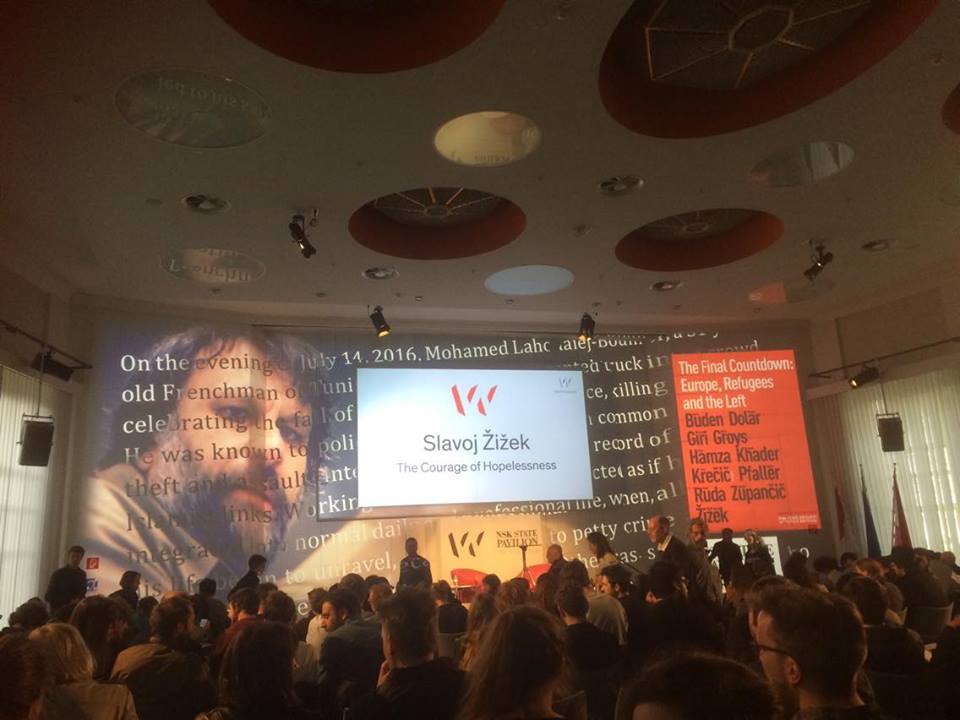
[smiths] magazine: Slavoj Žižek ‘The Courage of Hopelessness’ at AK Wien Bildungszentrum, Vienna. 20/05/17
The annual climax of the Viennese cultural calendar can only
be Festwochen; the Austrian capital’s
culture festival held this year between 12th May-18th
June. Established in the 1950s, Wiener
Festwochen remarks on its website,
‘[it was/is] necessary to reconnect with the world, to integrate the city and
the country into the international discourse of art and culture, to promote
life, openness, and the idea of a future’. Events span theatre, dance,
art-installations, music and lectures; celebrating individuals at the forefront
of socio-political activism, avant-garde artistry and intellectual thinking. The festival is heavily subsidised by the Austrian
government and though many of the events are ticketed roughly between €10- €65,
a reasonable amount of the events that take place over Festwochen were free- including those by postcolonial celebrity Gayatri
Chakravorty Spivak, Hegelian-Marxist and movie-pundit Slavoj Žižek and Fannie
Sosa’s sex-positive Feminist ‘twerkshop’. A premium cultural smorgasbord.
It was as part of ‘The Academy of Unlearning’ lecture series
that Slavoj Žižek’s lecture on ‘The Courage of Hopelessness’ was positioned; a
collection of lectures touching on Western democracy, social dislocation and
the European migrant crisis- encouraging participants to tap into a system of
re-education and critique individual boundaries of understanding.
As an intellectual who is perhaps both admired and lambasted
in equal measures by contemporary medias, Slavoj Žižek has an unshakable cult status
amongst memes junkies and uni-educated white Corbynites alike. The Ed Sheeran
of the hard-Left if you will; Žižek fronts a shy-boy scruffy exterior that
downplays ‘intellectual genius’, idolised by his adoring disciples. Žižek’s writings on Ideology, Psychoanalysis
and Film Theory- famously popularised for the mass-market in films The Pervert’s Guide to Cinema (2006) and
The Pervert’s Guide to Ideology (2012)
cemented him as the poster-boy for Hegelian-Marxism, prescribing a
transcendental celebrity glow to his characteristic idiosyncrasies and habitual
mannerisms.
Following the publication of ‘The Final Countdown: Europe,
Refugees and the Left’, Žižek’s essay and lecture title derives from the
Italian philosopher Giorgio Agamben claim that “thought is the courage of
hopelessness”. Speaking in the present tense, Žižek underscores the bleakness
of European politics with destructive language, ‘The true courage is to admit
that the light at the end of the tunnel is most likely the headlight of another
train approaching us from the opposite direction’. Exploring this prophetic
collision, he goes on to mark this oncoming threat as the ‘flow of refugees’ or
‘the problem of refugees’ that will certainly ‘explode again’. His central
claim here is (perhaps unsurprisingly) radical, calling for a ‘move away from
the humanitarian’.
‘This fascination with refugees
suffering is the ultimate fetish because it changes a mega serious political
problem into a humanitarian concern, and sentimental liberals always like this,
to change again and avoid critical political analysis and begin to talk this
rubbish of “are our hearts open enough”? [...] We don’t need open hearts we
need precise political action to break this cycle of global geopolitics’
Interrogating the difficulty of multiculturalism, Žižek
points the finger at the ‘the burden of a specific way of life’ and the
ambiguities that surround this ‘way’ as a point of conflict and uncertainty.
Using the Lacanian notion of
‘jouissance’, Žižek consolidates the notion of a ‘way of life’ as ‘not direct
pleasure but the enjoyment of organising pleasure’ culturally organised in such
a way that it ignores cultural attitudes to sexual customs and hierarchy as
values that exist ‘at the very core of a way of life’. Žižek presents the idea
of arranged marriages as a key component to a way of life, citing cultural
conflicts within his native Slovenia, as well as looking at the model of the
Indian caste system as a way of life that was used to the benefit of British
imperialism, stating that ‘authentic imperialism has always been
multicultural’.
The discourse is dense and pessimistic, focus turning to the
recent French election and the futility of neoliberal politics, ‘Macron
embodies politics that produced Le Pen’ and Žižek asserts despondently; ‘a vote
for Macron is a vote for Le Pen in four years time’.
At one point, Žižek confesses to having streamed the recent
adaptation of Margaret Atwood’s The
Handmaid’s Tale on piratebay (‘I caught myself enjoying it very much, I was
horrified’). Broadening into a Lacanian discussion on the sources of pleasure, Žižek
digresses into an account of rape of which the perpetrator denied being
motivated by carnal desires and was thus considered innocent by the Mexican
authorities. Here, Žižek revisits his trope that ‘of course, feminists
explode’, marking the Left’s obsessive preoccupation with safe-spaces and a
general emotional excess with his argumentation teetering towards the Right.
The attention to detail in describing the account as well as the depiction of
graphic violence in the screened video clip underscores Žižek’s inability to
censor or shelter. This extends to his provocative brand of apathetic humour,
and on a theoretical level in the assertions of his lecture argumentation that
calls for a move away from humanitarianism. Who needs trigger warnings, right?
The proceeding Q&A followed in a very Žižekian manner,
scrutinising the mediation of pre-meditated questions through a host and
reminding the audience to save their clapping for when they are directed,
signposting the conventions of a conference.
The initial question: ‘How did you sleep yesterday?’ is met with
frostiness that exposes Žižek’s personal brand of radical humour through
juvenile hyperbole ‘What is the point of this question? If you put it the way
you have put it, it would be like I have raped five children.’
As he tries to engage in a direct Q&A with audience
members Žižek confesses ‘I feel bad. The best thing would be to- this is
deepest anti-feminist manipulation- have a lady ask the questions so that we
can say that ladies were also- you know.’ Though Žižek does undoubtedly
recognise the extremes of his humour as an alienating factor, what is posed as
a noble intervention for the sake of inclusion is dashed as soon as the
audience member is chosen- an older Austrian man- over the energetically waving
arm of a female audience member. In doing this, Žižek reduces a demonstrative
act to a futile pledge to compensate for his poor taste in humour, further
isolating the voices of Left-wing women within a panel and audience largely
made-up of men. Žižekers hang off their demi-god’s every word, praying for the
next available moment to laugh heartily and declare their commonality.
In sum, I’m a sucker for free culture. Festwochen’s scintillating selection of scholars, exhibitions,
installations and performances had me from the word go, and the accessibility
of free entry is a credit to the Austrian government and Arts funding.
Hey, maybe I am a misguided, hysterical ‘exploding feminist’
but declaring progress to be a move away from empathy is certainly heavy
handed.
written for [smiths] magazine: http://www.smithsmagazine.co.uk/2017/09/04/vienna-festwochen-slavoj-zizek-the-courage-of-hopelessness-at-ak-wien-bildungszentrum-vienna-200517/
Elinor Potts

Sunday, 21 May 2017
Hinds Band Review for Cool Brother zine

Hinds are a fully-charged female four-piece hailing from
Madrid, favoured by the likes of Primal Scream’s Bobby Gillespie. Comprised of
Ade, Amber and front-girls, Carlotta and Ana, we’ve seen them escalade in size,
strength and following.
It all began two years ago, when 2014 saw Ana and Carlotta
release their debut EP, Bamboo.
Charming, fun and totally badass, Bamboo
is a pared back lo-fi rock ‘n’ roll ditty with a shoe-scuffing call and
response to playground pining. They’ve
hardly been sitting pretty since. That year, we watched Hinds battle intimate
venues like Corsica Studios, while remaining deers in the headlights when it
came to interacting with the crowd. Incessantly giggling, dewy-faced and
doe-eyed, they were still getting to grips with the English language. In 2015,
we were treated to a wealth of gigs, from Hong Kong to Hoxton, and 16
performances at SXSW. Now, they’re headlining Koko, they’re playing Glastonbury
two years in a row and they’ve performed along side the likes of The
Libertines, The Black Lips and The Strokes.
Yet, despite
being on the road more than Kerouac, they still found the time to write
and record debut album, Leave Me Alone. Suitably
evocative of teenage rebellion, it goes hand-in-hand with their nonchalant
attitude. Stand-out tracks include Garden
and the toe-tapping Warts; a cautionary
tale of a psycho witch, delivered with a playful lure; ‘She acts too crazy/Absurdly wild/Always ready for a winky/She always
burns her warts’.
They’ve achieved a lot in two years. Promising an
electric and thoroughly vivacious live performance, Hinds are definitely ones
to circle in your festival programmes this summer.
Thursday, 30 March 2017
Notes from Vienna
The Erasmus student is a dying breed, and as one of the last
years of Goldsmiths exports (NB: they’ve pledged to continue the scheme for the
next two years) I shall hereby present to you an account of the first month of
life in Vienna which has taken form in roughly 5 non-chronological chapters:
1) Sprechen Sie Englisch?
Upon receiving confirmation last August that I would be
studying in Vienna for my second semester I swiftly downloaded Duolingo and
smugly assumed that I was already part-way to learning fluent German. A few
weeks of sporadic testing and I could confidently declare that ‘the beetles
drink milk’ which made me strongly evaluate the relevance of vocabulary
available on Duolingo and so I consequently stopped trying entirely. As a result
I now have a purely beetle-based understanding of the German language and am
thus finding it somewhat troublesome navigating social situations. Despite
being anxious to avoid the stereotype of the Brit abroad as overly reliant on
the assumption their host will speak English, I have in no way deviated from
this stereotype, thus finding myself in a constant state of self-deprecation,
idealistically guessing my way through the entire language with my knowledge of
English, Swedish and smiles (the universal tongue).
2 2) Transition
Comparatively, rent in Vienna is an absolute pinch and close
to half of what I had been paying in Deptford so I really shouldn’t be
complaining. Unfortunately this has come at the cost of my beloved
student-living disarray that seemingly does not extend to Austrian student digs
owing to a non-exhaustive list of house rules that I am penalised for failing
to abide by.
If I were to describe the lavish architecture of Vienna to a
South East Londonder I would liken it to Deptford Town Hall x100. It’s
objectively jaw-dropping and a perpetual delight. From the University building
itself to parliament, the museum quarter, grandiose theatres and opera houses,
strolling around the city is a constant thrill. For those who feel culturally unfulfilled
in spite of the intimidating rich cultural backdrop of Vienna, there is an
opera themed public toilet in Karlsplatz station that charges you 50 cent to
piss to Strauss; an exercise easily achieved in the comfort of your own home
for the price of a Spotify premium account.
3 3) Nose-diving into a life of meat- my
passionate affair with a Käsekrainer
Away from the judgements of South-East vegans, I have
developed a deeply spiritual connection with the Austrian witching-hour
delicacy known as the Käsekrainer or ‘Carniolan sausage’ over the course of
this month. For those of you who are unfamiliar with this work of
Austro-Hungarian genius, the Carniolan sausage is a dish of true perfection; a
pork (?) sausage internally laced with hot cheese between a waistcoat of
baguette. But beware: this ambrosial masterpiece is served with a side order of
risk, as the visitor’s guide to Vienna advises; ‘if you’re not careful, a
sufficiently-distressed Käsekrainer can propel hot fat huge distances,
necessitating the wearing of protective goggles.’[1].
For those of you hankering for a sample, there are various restaurants around
London that serve the dish, though in much more formal setting. This is a dish
best served Wasted.
Asides from national specialities, the discovery of the
pay-as-you-wish restaurant Der Wiener Deewan has entrenched meat-eating habits
with a delicious selection of all-you-can-eat set curries for whatever price
you feel is most fair. This frankly blew the collective minds of me and my
culinary companion, opting for a medium sized mains portion and dessert for €6.50
each. My newfound meat-based lifestyle is delicious and I am never turning
back.
4 4) Rebirth/ Running around/Foreign territory
As a response to chapter 3 and with all this abundant spare
time that I used to fill with socialising and evenings at the Marquis of Granby
I decided to invest my time and physical energy in the preconception of the
Erasmus student as self-interested. The transition to healthy-Goth (a reworking
of the notion of Health Goth with a diminished emphasis on the aesthetic) has
been a tale of two halves; thwarted somewhat by the devilish presence of cheap
European cigarettes and bottles of Prosecco at €3 a pop. In the first week I
donned my optimistic gym wear and triumphantly announced to my new housemates I
was going on a run in a (rehearsed) nonchalant tone, hereby marking my new
persona as part-time runner. Leaving the flat I found myself blindly ‘running’
around the local neighbourhood block-by-block, polishing off this athletic
venture with a stroll around the local Austrian equivalent of Waitrose, and
window shopping for food in sports-gear. I cheerfully imagined the telephone
conversations of my flatmates, ‘Our new flatmate’s great, she’s only been here
two days and she’s always out running!’. Such painfully unsustainable
lies.
5 5) Brexit Repentance (BrePentance?)
The legacy of June 23rd is still hot on the tongues of many Austrians when you confess British nationality. Furthermore, having opted for more Cultural Theory based modules at the University of Vienna I am given daily reminders of the brutal history of British colonial imperialism and am plagued by a cloud of generally perpetual guilt. All in all, it’s not a great time to be a Brit abroad and as a some-time bar-dwelling exchange student, you’ll constantly find yourself haplessly apologising on behalf of your country’s idiocy. I’ve taken to wearing my ‘Don’t blame me I voted Remain’ badge regularly to avoid confusion.
I recently attended an event hosted by the university welcoming incoming exchange students that fell on the day that the UK formally began the process of leaving the EU. Speaker Heinz Fassmann (Vice-Rector of International Affairs) asked for a show of hands of UK students and later approached me after the speeches (regrettably directly after I had launched myself at the most handsome buffet I have ever witnessed) asking me- essentially on behalf of all Erasmus departments in the UK, what was going to happen to the scheme moving forward, as 50% of students of the University of Vienna seek an exchange to the UK. What then ensued was a furious rant delivered between mouthfuls of smoked salmon and red wine about the monumental confusion of Brexit and lack of understanding surrounding EU-funded schemes and free movement going forward. The lethal mixture of Brexit-talk and a free bar left me thoroughly red in the face.
This has been life thus far; a whirlwind few weeks of flustering around in a holiday-mode daze that I’m reluctantly emerging from. Am I integrating? Maybe. I’ve invested in some red slippers emblazoned with ‘Austria: Vienna’ in white stitching so I guess I am part there. Unfortunately I didn’t inspect said slippers thoroughly enough and it turned out that I’d purchased two left shoes. Hopefully this isn’t some horrible metaphor for bumbling through life.


Words by Ellie Potts.
Written for publication in [smiths] magazine, all rights reserved.
[1] http://www.visitingvienna.com/eatingdrinking/food/kasekrainer/
Monday, 27 February 2017
Mike McCormack in Conversation with Blake Morrison for [smiths] magazine
Speaking in the wake of his success, Mike McCormack explored the creative process in crafting his 2016 Goldsmiths Prize winning novel Solar Bones. As an inventive and experimental work, McCormack’s novel surpassed the criteria to ‘open up new possibilities for the novel form’ and as the fourth winner of the prize, McCormack follows in the line of distinguished previous winners including Eimear McBride, Ali Smith, and Kevin Barry.
Being McCormack’s third published novel, he professed his fluctuating successes that eventually bred Solar Bones. McCormack’s first edition of short stories Crow’s Requiem published in 1986 emphatically “divided the world”, receiving what McCormack confessed as the worst review he has ever seen; lamenting the felling of trees for the book’s print and despairingly noting ‘I can think of nothing good to say about this book’. What proceeded was what McCormack describes as “ten years of nothing” following being dropped by his publisher after the publication of Notes from a Coma. To Morrison however, the arresting opening of Solar Bones was what set the novel apart from others on the shortlist, highlighting the vivid depiction of a deconstructed tractor that marks the protagonist Marcus Conway’s fascination with the fragility of the universe and the process of disassembling.
As a novel written in a single sentence, McCormack was keen to shy away from the labels of stream of consciousness narrative, marking the continuous fluidity between thoughts of the ghostly narration that fails to lapse. In spite of McCormack’s absence of grammatical punctuation, he utilises white space as a means of punctuating and describes the novel as “easiest understood as an Aria”. Whilst radical in form, McCormack blends an amalgamation of high and low brow culture, making biblical allusions alongside reference to Radiohead albums that he declared as following in the tradition of Thomas Pynchon; the “giver of license to low comedy”.
Through McCormack’s brief experience having trained as an engineer, he foregrounds the importance of working characters to stimulate “pulse and routine”. “Engineers build the world” he declared, “they facilitate every moment, this lecture hall is conceived through an engineer”. As a graduate of English and Philosophy from the University of Galway, McCormack also commended the influence of artists and creatives on his craft that manifests in the novel through Marcus’ artist daughter. The fragmentation of form and dispersion of words across the page within Solar Bones is therefore indebted to the influence of McCormack’s artistic tradition and the visual aesthetic of paragraphs that tend to “stand and stare”. McCormack also attributed his visual awareness of artistic forms to the influence of his wife as an artist and the process of staring at a white canvas waiting for images to emerge.
As a novel that charts the male experience, McCormack was keen to mark the shades of masculinity that are present within the novel and stressed that the heroes of the novel are all women. The dominance of women throughout the creative process was touched upon by Morrison through McCormack’s female agent and the publishing of the novel by the Irish publishing company Tramp Press run by Lisa Coen and Sarah Davis-Goff- as well as the process of selection for the Goldsmiths prize, with Morrison being the only male member of the panel.
McCormack communicated a deep familiarity with the environments and routines of his characters and there is a Joycean geographical precision to the locations they inhabit, informed by the epidemics of water contamination near Galway that resonate within the novel. Whilst Morrison marked the British publishing industry ‘the most conservative in the world’, McCormack praised the presence of platforms such as the Goldsmiths prize for championing innovative fiction such as this. Despite the shortfalls of the British publishing industry that did not wholly mesh with the Irish imagination, McCormack honoured his own publishers for “getting it” and not having to explain the condition of the novel and later recognising the rising movement of young Irish writers such as Clare Louise Bennett and Eimear McBride with her open acknowledgement of the influence of Joyce upon her work.
The evening invited a thoroughly intriguing introduction to an original and organically artistic work of innovative fiction.
original article available at:

Subscribe to:
Posts (Atom)