Written for publication at UnderPinned.co:
https://underpinned.co/2018/10/theatre-review-wise-children-at-the-old-vic/
CW: On-stage suggestions of sexual abuse, miscarriage, and incest.
Reworking Angela Carter’s 1991 novel Wise Children, Emma Rice’s theatrical imagining of the text is an explosive ode to the carnivalesque and a sensuous, bohemian feast of a pantomime. It’s a haunted fairytale which explores the shades between good and evil with darker moments offset by nostalgic musical numbers. The scene is a Brixton car-park in 1989 and our protagonists are twin sisters Dora and Nora Chance, accompanied by a gaggle of pastel-coloured mime artists and leggy thespians. A live band play a bewitching score in an alcove behind the centre-stage caravan and beneath the bulb-lit lettering of ‘Wise Children’, keeping guard of the pair. We meet the sisters on the day of their 75th birthday when they are unexpectedly delivered with an invitation to a birthday party from their estranged father, the actor Melchior Hazard. ‘There may be trouble ahead!’ the company croons, and the narrative sketches their complex and adulterous lineage, through which we meet a diverse host of eccentric and extraordinary members.
The importance of Shakespeare to the text is an intriguing thread which certainly feels appropriate given the timings of Rice’s departure from the Globe theatre. There’s a disdain for convention and a playful approach to gender and role-swapping with Ankur Bahl playing both the young Melkior and, later, the bratty female RADA student with whom Melchior has an affair. Katy Owen’s portrayal of the bawdy Grandma Chance is particularly worthy of praise and nothing short of comic brilliance. She has a stubborn disposition and as the parental guardian of the young girls, she spends her days drinking stout and delivering life lessons to the girls, most of which are conducted whilst Owens dons a plump (nude) fat suit with tastefully bejewelled areola and pubic region. The play’s set and costume design, overseen by Vicki Mortimer, is a visual pleasure, wonderfully camp and charmingly mismatched; wigs poorly fixed with sagging lace-fronts; ungodly high-waisted trousers and lashings of gender-bending and breaking. The musical number at the beginning of the second act confirms this as they sing, “Girls will be boys when they want their own way . . . there’s a sudden realization at the end of the play, that we’re all a bit distracted by the choice of passageway!”. This is Rice at her absolute finest.
Showing posts with label theatre. Show all posts
Tuesday, 16 October 2018
Theatre Review for UnderPinned freelancing magazine; Mrs Dalloway at the Arcola
Written for publication at UnderPinned.co :
https://underpinned.co/2018/10/mrs-dalloway-at-the-arcola-theatre/
This adaptation of Virginia Wolf’s Mrs Dalloway isn’t for everyone. For some, it is a chaotic and claustrophobic clamour of self-indulgent Modernism. For others, it is a chaotic and claustrophobic clamour of self-indulgent Modernism. Attending to Virginia Woolf’s essay ‘Mr. Bennet and Mrs. Brown’, Hal Coase deduces that the text’s primary occupation is that of character formation, with an eye to Woolf’s distrust of “theatrical moments which might deliver the ‘final’ truths of life”. Drawing upon the rich catalogue of writings on and by Woolf, her eccentric creations are tastefully draped in muted beige linens with a background of white drapes. It’s minimalist to the extent that it habitually relies on narrative descriptions to project the image of London. Coase’s refusal to wholly visualise the setting is an abstract and painterly decision which is in keeping with the expressively experimental sentiment of the text but is also, albeit, a little lazy.
Before we meet Clarissa (Clare Perkins), the rest of the cast sketch her character by listing her traits until they grow restless at the redundancy of language and limits of knowledge. “There is never enough of someone to make a judgement”, they surmise. The four cast members disperse like birds into the four corners of the room, playing metropolitan ‘found-sound’ on cassette players in a contemporary flourish. Thus, the character of Clarissa Dalloway is born, clutching (fake) flowers, which she bought herself, against an Yves-Klein-blue canvas; one of few temporal markers. Later, a cloudier canvas is brought out to indicate the fading light.
There are several instances of wrongly executed and misspoken lines and the shaky synchronisation feels indicative of insufficient rehearsal. Despite this, there is a supremely accomplished and nuanced performance from Moody who brings surprisingly humorous tones to the characters of Miss Killman and Mrs William Bradshaw. D’Arcy’s monologue as Rezia is also worthy of note, her musical Italian timbre summoning audience tears as she pleads for her shell-shocked husband’s sanity. In its denouement, the play pulls together its aphoristic threads in the aftermath of Septimus’ death. “To love makes one solitary”, is one, “the people we are most fond of are no good for us when we are ill”. In this, the cynicism of Woolf’s earlier mentioned distrust for theatrically delivered truths is lost, operating more as moral lessons than sardonic phrases.
Whilst it might not be as beautiful as Woolf’s prose, Coases’ theatrical imagining of Mrs Dalloway must be credited for its ambition in adapting such a well-loved canonical Modernist text. The adaptation might not be a meticulous reiteration of the original, it’s every bit as cluttered and befuddled as urban life has always been.
Labels:
adaptation,
arcola,
clarissa dalloway,
dalloway,
dalston,
drama,
journalism,
london,
magazine,
modernism,
mrs dalloway,
play,
review,
theatre,
underpinned,
underpinned.co,
virginia,
woolf
Sunday, 20 May 2018
Review: Mood Music at the Old Vic for AYT
Propelled by the anxious collision of psychological expression and repression, Mood Music interrogates the boundaries of creative ownership and the extent to which we are emotionally invested in our artistic products. Written by Joe Penhall (Sunny Afternoon, Blue/Orange) and directed by Roger Michell, the piece chronicles the ego-clash of producer Bernard (Ben Chaplin) and wide-eyed vocalist and protégé, Cat (Seána Kerslake). After moving to London from her native Dublin, Cat is scouted by the esteemed producer who promises fanciful collaborations, avowing that he is “no stranger to excitement”. Dialogue splices between conversations with their respective doting psychotherapists (Jemma Redgrave and Pip Carter) on a stage decked with a low ceiling of vintage microphones.
The relationship between the two soon turns sour. Cat becomes increasingly demystified by the façade of musical success and pines for a ‘purer’ method of musical expression to spiritually reconnect with her deceased father. Studio quarrels are spurned by Bernard’s self-assured musical machismo and confident misogyny. The trope is all too familiar and he is superbly repugnant. The declaration by Bernard’s Lawyer (Neil Stuke) that “It’s time to change the balance of power… within reason” illustrates the extent to which misogyny is embedded in the operation of the music industry and manifests throughout the play’s legal struggles and the propagation of Bernard’s intuitive ‘genius’. “We’re essentially midwives, but the songs are our babies” he affirms. In this, and other references to songs as his “babies”, we see the heart of Bernard’s quest to erase female presence and stabilise his unstable identity. Chaplin’s performance garners audience chuckles, which I suppose is either rooted in his brashly exuding charm or their own reflective identification. I’m impressed, but as a young female creative I’m far from amused.
Ultimately Cat descends into substance dependency in the midst of legal toils as she struggles to rationalise her trauma. There are moments when the language feels cheap, underscoring the soulless performativity of the industry as Bernard philosophises “Sometimes the dark heart of a song can never be known because frankly it’s too squalid”. For a play centred on the production and performance of music, there is surprisingly little actual music, albeit a sorrowful string-ensemble conducted by Cat which concludes the evening and injects a grain of optimism to the story of female creative and legal oppression. Whilst it might be a bitter pill to swallow, Mood Music is a timely rumination on the purpose of psychotherapy under capitalism and its use in fostering creative production and profit at the expense of those too weak to speak out.
*************
Written for A Younger Theatre magazine, link here: https://www.ayoungertheatre.com/review-mood-music-the-old-vic/
The relationship between the two soon turns sour. Cat becomes increasingly demystified by the façade of musical success and pines for a ‘purer’ method of musical expression to spiritually reconnect with her deceased father. Studio quarrels are spurned by Bernard’s self-assured musical machismo and confident misogyny. The trope is all too familiar and he is superbly repugnant. The declaration by Bernard’s Lawyer (Neil Stuke) that “It’s time to change the balance of power… within reason” illustrates the extent to which misogyny is embedded in the operation of the music industry and manifests throughout the play’s legal struggles and the propagation of Bernard’s intuitive ‘genius’. “We’re essentially midwives, but the songs are our babies” he affirms. In this, and other references to songs as his “babies”, we see the heart of Bernard’s quest to erase female presence and stabilise his unstable identity. Chaplin’s performance garners audience chuckles, which I suppose is either rooted in his brashly exuding charm or their own reflective identification. I’m impressed, but as a young female creative I’m far from amused.
Ultimately Cat descends into substance dependency in the midst of legal toils as she struggles to rationalise her trauma. There are moments when the language feels cheap, underscoring the soulless performativity of the industry as Bernard philosophises “Sometimes the dark heart of a song can never be known because frankly it’s too squalid”. For a play centred on the production and performance of music, there is surprisingly little actual music, albeit a sorrowful string-ensemble conducted by Cat which concludes the evening and injects a grain of optimism to the story of female creative and legal oppression. Whilst it might be a bitter pill to swallow, Mood Music is a timely rumination on the purpose of psychotherapy under capitalism and its use in fostering creative production and profit at the expense of those too weak to speak out.
*************
Written for A Younger Theatre magazine, link here: https://www.ayoungertheatre.com/review-mood-music-the-old-vic/
Labels:
drama,
london,
mood,
mood music,
music,
old,
old vic,
review,
the old vic,
theatre,
vic,
waterloo
Tuesday, 28 November 2017
Review: The Suppliant Women at the Young Vic: for [smiths] magazine
Ferociously executed and deliciously, faultlessly synchronised, David Greig’s revision of Aeschylus’s play, The Suppliant Women is in the spirit of the community-based original. Greig’s reworking of the text has been championed by community choruses in Edinburgh, Belfast, Newcastle and Dublin and now takes pride of place in London’s Young Vic theatre. It charts the journey of fifty women, daughters of Danaos, from Egypt to Greece fleeing forced marriage with their cousins, the “unholy sons of King Aegyptos”. The Suppliant Women presents the female condition in flight, navigating Diasporic identities under a strict patriarchal thumb. In keeping with Ancient Greek performance, the evening is prefaced by an announcement from a civic official; Conservative MP John Glen, parliamentary under-secretary for Arts, Heritage and Culture. Glen recites the names of the play’s sponsors, marking government subsidisation of the arts through percentages of ticket prices. Glen conducts a libation, pouring a bottle of red wine along the porous grey stone of the open stage, squawking “in the name of Dionysses, god of wine, rejoice!” I find the inclusion of a true-to-life politician here intriguing. When theatre is so often a place to evade reality, Glen injects realism and reminds the audience of their benevolent rulers and the cultural allocation of their taxes.
Women are at the heart of this play, and the chorus rightfully take centre stage. It is a patchwork flurry of multi-coloured women, all residents of Southwark- having trained for the play since September under the direction of Ramin Gray, choreographer Sasha Milavic Davies and vocal leader Mary King. The chorus of women largely operate as one body, only splitting off to individual voices in times of crisis, Gemma May giving a highly commendable performance as chorus leader. The use of incense, candles, torches, flapping scarves and confetti all invite a high sensory engagement. Live percussion and woodwind accompanies Greig’s rhythmically loaded language, reminiscent of Kate Tempest’s metered delivery, albeit en-masse. The women brandish suppliant branches threaded with white fabric which they use to simulate the motion of their journey by sea, swing over their heads and lay down as offerings to their recipients. The women are plagued by the violence of men, their attractive youth and their vulnerability as asylum seekers, crying “the worries of women as exiles are endless”. This speaks of a universal female condition; their only bargaining chip in the kingdom of men being the threat of self-destruction through suicide, cursing the city of Argos. This is a play that ruminates on human migration and attitudes towards migrants, transcending the historicity of the original; “if you’re a migrant the people will talk”.
"Equal power to all Women" is the triumphant closing war-cry. It is eternally relevant.
********************************
Words by Literary and Creative Editor, Ellie Potts.
--- @eldpotts
Women are at the heart of this play, and the chorus rightfully take centre stage. It is a patchwork flurry of multi-coloured women, all residents of Southwark- having trained for the play since September under the direction of Ramin Gray, choreographer Sasha Milavic Davies and vocal leader Mary King. The chorus of women largely operate as one body, only splitting off to individual voices in times of crisis, Gemma May giving a highly commendable performance as chorus leader. The use of incense, candles, torches, flapping scarves and confetti all invite a high sensory engagement. Live percussion and woodwind accompanies Greig’s rhythmically loaded language, reminiscent of Kate Tempest’s metered delivery, albeit en-masse. The women brandish suppliant branches threaded with white fabric which they use to simulate the motion of their journey by sea, swing over their heads and lay down as offerings to their recipients. The women are plagued by the violence of men, their attractive youth and their vulnerability as asylum seekers, crying “the worries of women as exiles are endless”. This speaks of a universal female condition; their only bargaining chip in the kingdom of men being the threat of self-destruction through suicide, cursing the city of Argos. This is a play that ruminates on human migration and attitudes towards migrants, transcending the historicity of the original; “if you’re a migrant the people will talk”.
"Equal power to all Women" is the triumphant closing war-cry. It is eternally relevant.
********************************
Words by Literary and Creative Editor, Ellie Potts.
--- @eldpotts
![]() |
| Photo by Stephen Cummiskey |
Friday, 24 November 2017
The Famous Lauren Barri Holstein: Notorious at The Barbican: Review
Drawing on the canon of queer and radical feminist
performance art, Lauren Barri Holstein’s Notorious
at the Barbican Centre is a slap in the face of convention. Alternatively known
as ‘The Famous’, Holstein pushes, prods and (literally) pisses on formal
representations of the female body in an anarchic, brash cacophony of saccharine
pop, feathers and vaginal secretions; foregrounding the abject.
The stage is a greyscale, decadent assembly of chandeliers
and velvet drapes soundtrack to a looped clip of a crackling gramophone. Nestled
in the Barbican’s basement Pit theatre, Notorious
is tucked away sub-street level like a naughty secret, driven to the
underground whilst some lofty Shakespearean production takes place several
metres above our heads.
Notorious opens
with plumes of smoke and three witchy corpses hanging behind the weighty curtains;
humming and groaning in and out of harmony with each other. Ghostly legs protrude
from beneath uniform dresses styled from tresses of grey hair extensions. “So
there are rumours going around about me- have you heard them?” Holstein purrs,
in hushed Kardashian tones. Her face is projected in real time, luminous green onto
feathered curtains. The curious backdrop gives the projection a textured distortion,
amplifying her exaggerated features. Holstein parades the video camera, the LED
screen reflecting a mirror image back towards her. She confesses stories of
sleeping in forests, decomposing corpses and animals penetrating her vagina-
all delivered in a thick, breathy whisper. Her words are laced with conspiring voices, blurring
the distinctions of truth and reality in performance and systematically critiquing
her exaggerated gender performance.
She surveys the audience and thanks former students for
attending, momentarily dropping the valley girl guise to assume her reality as an
academic at Queen Mary University. Holstein convulses erratically, sound
tracked by Miley Cyrus’s “We Can’t Stop”, madly jerking at her pubis and imitating
a crudely explosive orgasm somewhere between twerking and electrocution. The final
flourish is a jelly snake emerging from her vagina whilst gyrating, gazing into
the audience and subsequently eating it. Holstein is unsettling, brash, and
quite frankly- punk as fuck.
Her wig falls off in the frenzy, unabashedly revealing an
exposed flesh coloured skull-cap that mutates her complex gender identity. What
follows is a series of shrill confessions, “I know that I can be a whore
sometimes and also I’m really sorry for being such a slut [...] last night I
snuck into your flat and replaced all of your garbage bags with female condoms
because they’re roughly the same size”. A grizzly series of apologies follow
from Holstein’s spooky minions (Krista Vuori and Brogan Davison), charting bestiality,
abused tampons and vomit-related blunders, drawing on audience members to
project their pleas for pardon. These become more and more farfetched, questioning
feminine exteriority. “I’m really sorry about my face” grins Krista,
maniacally. She proceeds to imitate her own suicide, hanging to her “favourite
song” No Limit by 2 Unlimited. After
a minute or so, Krista tires of the hanging and starts feverishly bounding in
time in to the music.
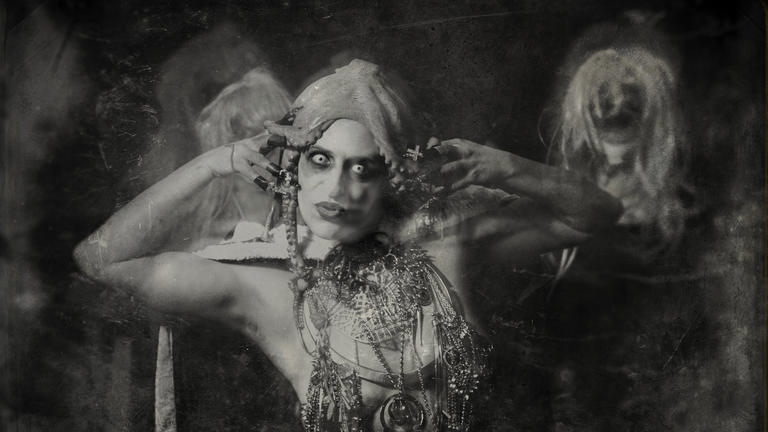
Holstein dons a squid wig and a dress made of beads and
braids that expose her bare breasts. Retrieving the video camera, she fishes
the lens between her labia before asking “familiar?”. Soon we notice an
artificial eye has been placed inside her vagina and Holstein twists her legs, making
the lips of her labia open and close imitating a winking eye. “Vaginas are
hilarious you guys” she snarls, before placing the ball in her mouth and sucking,
chewing and spitting the putrid orb to the beat of Nicki Minaj’s “Starships”. Holstein
starts to deconstruct her fishy headdress, pulling it tentacle after tentacle
and smacking them against her own body in an act of voyeuristically motivated
self-flagellation. A lone tentacle flies into the audience, she kisses the residual
legs. The track loops and Holstein is suspended and bound and passing on the remaining
tentacles to her minions she is lightly whipped. Thereafter, Brogan is told to “incorporate
a lesbian sex scene” and delivers an x-rated monologue, fancifully inconsistent
and aligned with the male gaze of contemporary pornography. The absurdity of
the story reaches its climax as Brogan screams of being “furiously fisted with
pizza”.
Holstein is suspended again, this time with the cry that “I
need to purify myself”. She inserts test-tubes of coloured paint, confetti and coins
into her vagina to the tune of Disney’s “Let it Go” and Miley’s “Wrecking Ball”.“Are
you feeling better now? I’m feeling better” smiles Holstein, in-between gasps
for air. What’s interesting about all of the evening’s physically intense skits
is that despite the formal dance training of Holstein and her troupe, they are
thoroughly exhausted and breathless following each rendition; complaining and
swearing unrelentingly.
“You’re here so I
have to do something I suppose” she sighs, changing into her final incarnation;
a sickening agglomeration of a Lolita-style crop-top and skirt, topped with a
Rococo wig that she parades giggling, drinking soda and hula-hooping. As the
hoop presses against her diaphragm Holstein erupts with burps that intersect
her girlish giggles. She whines for want of a piss, spits out her mouthful of
soda, curtsies and projects a resounding belch.
Retiring to an armchair in the corner of the stage Holstein
reflects on her multiple forms, drifting between theatricality and presented reality.
“You guys, this is the real me, the pure me, I’ve been resurrected as a sexy
baby. This is how you should remember me... as I truly am.” This final form is
a “rebirth”, cultivated by the audience’s desires to witness a woman being
punished for her sexual agency because as Holstein rightfully articulates, “it’s
really enjoyable to feel pity”.
The performance culminates in an act of public urination over
a small heap of popping candy which Holstein eats (“I just had to!”). She submerges
her body in it, before finally assuming a highly dramatised “dead” pose, framed
by her two underlings as the gramophone crackle resumes and then swells into
Britney Spears’s “Work Bitch”.
In sum, Lauren Barri Holstein’s Notorious was born to unashamedly incite disgust. Holstein is no
stranger to hitting the press for her radical performance art, gaining
notoriety in The Telegraph in 2015 for showing clips from her production Splat! during her time as a first year lecturer
at Queen Mary University. Notorious
delights in Kristeva’s notion of the abject, and clumsily, stickily, meshes the
perverse with the intimate. But does it promise anything less? Of course not.
Despite critical lambasting from conservative publications, Holstein is making a
stern comment on the socio-cultural implications of hyper-sexualisation in the
post-modern age and interrogates the taboo and stigmatism that still pervades
the female form.
Notorious takes
the road:
18th November-Tjarnarbio, Every Body's Spectacular, Reykjavik, Iceland.
23rd November- Attenborough Centre for the Creative Arts, Brighton, UK.
Friday, 6 May 2016
Yours Ever Loving/The Frights: Review
![]() | |
| Louise Taylor's The Frights |
![]() | |
| Martin McNamara's Yours Ever Loving |
http://www.smithsmagazine.co.uk/2016/05/12/yours-ever-loving-the-frights-a-review/
Hosted at ‘Theatre N16’ located above the Bedford pub, Yours Ever Loving is performed preceding
The Frights; a poignant and political
duo assembled by the Newcastle based Alphabetti Theatre Company. Martin McNamara’s
Yours Ever Loving trails the trials
and tribulations of wrongly imprisoned 1974 Guildford bomber Paul Hill,
incarcerated through the political conflicts between Britain and Ireland and
only released in 1989. The piece is a whistle-stop tour through the 1970s/80s
with James Elmes embodying the domineering authority as Margaret Thatcher, a
Judge, a Kubrick-esque yob, brutish policeman, Roy Jenkins, Jimmy Saville and a
vicar, all with a startlingly electric delivery. It charts Hill’s fifteen year
prison stint informed through the letters he wrote to his mother during his
time away, intersected with radio broadcasts, news updates and popular hits
humorously relayed by Elmes. Stefan McCusker’s portrayal of Hill is remarkably
human, capturing issues of mental health, repression and the futility of
objecting when within a corrupt and horrifically abusive system.
Physically blindfolded from the offset, Louise Taylor’s The Frights follows. This is a riveting
play that charts the readmission of charity worker Hanny (Christina Berriman
Dawson) into mundane life following her enslavement by elusive foreign forces.
The inconsistency of Hanny’s account of her experience flags fears of deception
and the traumatic repression of the returned captive as she is soon united with
adoring partner Luke (James Hedley), who pines after the memory of the former
Hanny and is obsessively protective. The effect of the performance being
obscured through fabric neatly lends to the prevailing obscuring atmosphere with
jarring flashes of Hanny’s repression that manifest in audibly graphic torture
scenes, sharply contrasting the banality of the doctor’s waiting room. Directed
by the inaugurator of the Alphabetti Theatre Ali Pritchard, The Frights is a sensory and psychological
nightmarish voyage that shakes public perceptions of truth and the distinction
between sugar-coating and fabricating. It fundamentally critiques the nature of
the media platforms from which we receive information, scrutinising public
entitlement to information as well as questioning attitudes to international
charity and domestic hierarchy.
Subscribe to:
Posts (Atom)