Tuesday, 28 November 2017

Review: The Suppliant Women at the Young Vic: for [smiths] magazine

Ferociously executed and deliciously, faultlessly synchronised, David Greig’s revision of Aeschylus’s play, The Suppliant Women is in the spirit of the community-based original. Greig’s reworking of the text has been championed by community choruses in Edinburgh, Belfast, Newcastle and Dublin and now takes pride of place in London’s Young Vic theatre. It charts the journey of fifty women, daughters of Danaos, from Egypt to Greece fleeing forced marriage with their cousins, the “unholy sons of King Aegyptos”. The Suppliant Women presents the female condition in flight, navigating Diasporic identities under a strict patriarchal thumb. In keeping with Ancient Greek performance, the evening is prefaced by an announcement from a civic official; Conservative MP John Glen, parliamentary under-secretary for Arts, Heritage and Culture. Glen recites the names of the play’s sponsors, marking government subsidisation of the arts through percentages of ticket prices. Glen conducts a libation, pouring a bottle of red wine along the porous grey stone of the open stage, squawking “in the name of Dionysses, god of wine, rejoice!”  I find the inclusion of a true-to-life politician here intriguing. When theatre is so often a place to evade reality, Glen injects realism and reminds the audience of their benevolent rulers and the cultural allocation of their taxes.
Women are at the heart of this play, and the chorus rightfully take centre stage. It is a patchwork flurry of multi-coloured women, all residents of Southwark- having trained for the play since September under the direction of Ramin Gray, choreographer Sasha Milavic Davies and vocal leader Mary King. The chorus of women largely operate as one body, only splitting off to individual voices in times of crisis, Gemma May giving a highly commendable performance as chorus leader. The use of incense, candles, torches, flapping scarves and confetti all invite a high sensory engagement. Live percussion and woodwind accompanies Greig’s rhythmically loaded language, reminiscent of Kate Tempest’s metered delivery, albeit en-masse. The women brandish suppliant branches threaded with white fabric which they use to simulate the motion of their journey by sea, swing over their heads and lay down as offerings to their recipients. The women are plagued by the violence of men, their attractive youth and their vulnerability as asylum seekers, crying “the worries of women as exiles are endless”. This speaks of a universal female condition; their only bargaining chip in the kingdom of men being the threat of self-destruction through suicide, cursing the city of Argos. This is a play that ruminates on human migration and attitudes towards migrants, transcending the historicity of the original; “if you’re a migrant the people will talk”.
"Equal power to all Women" is the triumphant closing war-cry. It is eternally relevant.

********************************

Words by Literary and Creative Editor, Ellie Potts. 
--- @eldpotts
Photo by Stephen Cummiskey

Friday, 24 November 2017

The Famous Lauren Barri Holstein: Notorious at The Barbican: Review


Drawing on the canon of queer and radical feminist performance art, Lauren Barri Holstein’s Notorious at the Barbican Centre is a slap in the face of convention. Alternatively known as ‘The Famous’, Holstein pushes, prods and (literally) pisses on formal representations of the female body in an anarchic, brash cacophony of saccharine pop, feathers and vaginal secretions; foregrounding the abject.
The stage is a greyscale, decadent assembly of chandeliers and velvet drapes soundtrack to a looped clip of a crackling gramophone. Nestled in the Barbican’s basement Pit theatre, Notorious is tucked away sub-street level like a naughty secret, driven to the underground whilst some lofty Shakespearean production takes place several metres above our heads.
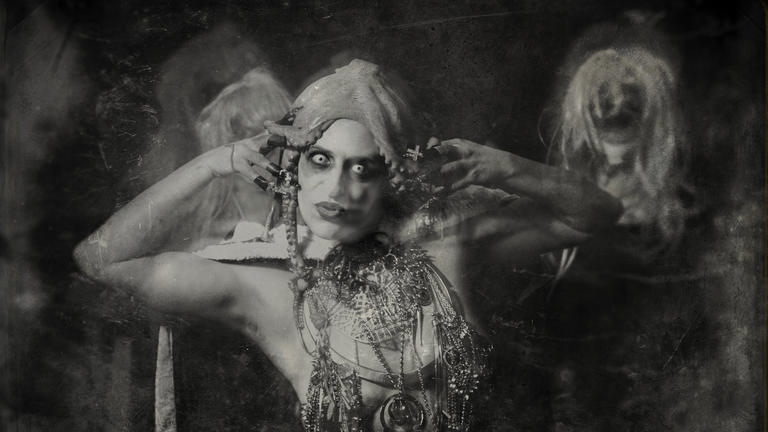
Notorious opens with plumes of smoke and three witchy corpses hanging behind the weighty curtains; humming and groaning in and out of harmony with each other. Ghostly legs protrude from beneath uniform dresses styled from tresses of grey hair extensions. “So there are rumours going around about me- have you heard them?” Holstein purrs, in hushed Kardashian tones. Her face is projected in real time, luminous green onto feathered curtains. The curious backdrop gives the projection a textured distortion, amplifying her exaggerated features. Holstein parades the video camera, the LED screen reflecting a mirror image back towards her. She confesses stories of sleeping in forests, decomposing corpses and animals penetrating her vagina- all delivered in a thick, breathy whisper.  Her words are laced with conspiring voices, blurring the distinctions of truth and reality in performance and systematically critiquing her exaggerated gender performance.
She surveys the audience and thanks former students for attending, momentarily dropping the valley girl guise to assume her reality as an academic at Queen Mary University. Holstein convulses erratically, sound tracked by Miley Cyrus’s “We Can’t Stop”, madly jerking at her pubis and imitating a crudely explosive orgasm somewhere between twerking and electrocution. The final flourish is a jelly snake emerging from her vagina whilst gyrating, gazing into the audience and subsequently eating it. Holstein is unsettling, brash, and quite frankly- punk as fuck.
Her wig falls off in the frenzy, unabashedly revealing an exposed flesh coloured skull-cap that mutates her complex gender identity. What follows is a series of shrill confessions, “I know that I can be a whore sometimes and also I’m really sorry for being such a slut [...] last night I snuck into your flat and replaced all of your garbage bags with female condoms because they’re roughly the same size”. A grizzly series of apologies follow from Holstein’s spooky minions (Krista Vuori and Brogan Davison), charting bestiality, abused tampons and vomit-related blunders, drawing on audience members to project their pleas for pardon. These become more and more farfetched, questioning feminine exteriority. “I’m really sorry about my face” grins Krista, maniacally. She proceeds to imitate her own suicide, hanging to her “favourite song” No Limit by 2 Unlimited. After a minute or so, Krista tires of the hanging and starts feverishly bounding in time in to the music.
Holstein dons a squid wig and a dress made of beads and braids that expose her bare breasts. Retrieving the video camera, she fishes the lens between her labia before asking “familiar?”. Soon we notice an artificial eye has been placed inside her vagina and Holstein twists her legs, making the lips of her labia open and close imitating a winking eye. “Vaginas are hilarious you guys” she snarls, before placing the ball in her mouth and sucking, chewing and spitting the putrid orb to the beat of Nicki Minaj’s “Starships”. Holstein starts to deconstruct her fishy headdress, pulling it tentacle after tentacle and smacking them against her own body in an act of voyeuristically motivated self-flagellation. A lone tentacle flies into the audience, she kisses the residual legs. The track loops and Holstein is suspended and bound and passing on the remaining tentacles to her minions she is lightly whipped. Thereafter, Brogan is told to “incorporate a lesbian sex scene” and delivers an x-rated monologue, fancifully inconsistent and aligned with the male gaze of contemporary pornography. The absurdity of the story reaches its climax as Brogan screams of being “furiously fisted with pizza”.
Holstein is suspended again, this time with the cry that “I need to purify myself”. She inserts test-tubes of coloured paint, confetti and coins into her vagina to the tune of Disney’s “Let it Go” and Miley’s “Wrecking Ball”.“Are you feeling better now? I’m feeling better” smiles Holstein, in-between gasps for air. What’s interesting about all of the evening’s physically intense skits is that despite the formal dance training of Holstein and her troupe, they are thoroughly exhausted and breathless following each rendition; complaining and swearing unrelentingly.
 “You’re here so I have to do something I suppose” she sighs, changing into her final incarnation; a sickening agglomeration of a Lolita-style crop-top and skirt, topped with a Rococo wig that she parades giggling, drinking soda and hula-hooping. As the hoop presses against her diaphragm Holstein erupts with burps that intersect her girlish giggles. She whines for want of a piss, spits out her mouthful of soda, curtsies and projects a resounding belch.
Retiring to an armchair in the corner of the stage Holstein reflects on her multiple forms, drifting between theatricality and presented reality. “You guys, this is the real me, the pure me, I’ve been resurrected as a sexy baby. This is how you should remember me... as I truly am.” This final form is a “rebirth”, cultivated by the audience’s desires to witness a woman being punished for her sexual agency because as Holstein rightfully articulates, “it’s really enjoyable to feel pity”.  
The performance culminates in an act of public urination over a small heap of popping candy which Holstein eats (“I just had to!”). She submerges her body in it, before finally assuming a highly dramatised “dead” pose, framed by her two underlings as the gramophone crackle resumes and then swells into Britney Spears’s “Work Bitch”.
In sum, Lauren Barri Holstein’s Notorious was born to unashamedly incite disgust. Holstein is no stranger to hitting the press for her radical performance art, gaining notoriety in The Telegraph in 2015 for showing clips from her production Splat! during her time as a first year lecturer at Queen Mary University. Notorious delights in Kristeva’s notion of the abject, and clumsily, stickily, meshes the perverse with the intimate. But does it promise anything less? Of course not. Despite critical lambasting from conservative publications, Holstein is making a stern comment on the socio-cultural implications of hyper-sexualisation in the post-modern age and interrogates the taboo and stigmatism that still pervades the female form.
Notorious takes the road:


All rights to Tim Fluck.

Saturday, 11 November 2017

The Letters of Sylvia Plath 1940-1956: Live at the Southbank

Letters of Sylvia Plath was an evening of scholarly spectacle and revelling at the brilliance of the late literary luminary; trailing the hefty publication of Sylvia Plath’s collected letters between 1940-1956 and a veritable staple of the Southbank Centre’s London Literature Festival. In the words of the Southbank, “The festival celebrates the role words can play in reimagining a world on the brink” and this year’s bill boasted everyone from Claudia Rankine to Tom Hanks and Hilary Rodham Clinton. As I glided over Waterloo bridge I couldn’t help but notice cascades of illuminated messages daubing the building’s exterior as part of the “Wall of Dreams” initiative for the Poetry International Festival; hopes and dreams of European refugees and migrants, setting a sombre tone and emphasising the importance of language, of self, and of action.
The evening was arranged with a panel of literary veterans; Eimear McBride, Max Porter, Sarah Howe and chaired by Lavinia Greenlaw, all clustered in the vast hall like some great cultural womb. Plath’s letters were read by Lydia Wilson following an introduction from Plath’s daughter Frieda Hughes. “She is best explained in her own words” Frieda began, marking  her respect for her father’s sensitive treatment of her mother’s literary catalogue and the posthumous publishing of Ariel. She praises her mother’s determination and formidable work ethic, evidenced at a strikingly young age in her letters. Plath’s first letter is written aged 7 to her father, and as Greenlaw notes, shows that she is “thinking about colour, pause and effect”, experimenting with the colours she writes in and dramatically varying sentence length. “I got ink on my fingers. I had to rub it off with a stone” Plath dreams, prophesising her poetic voice.
In a letter to her mother in 1943, the young Sylvia recounts a meticulous list of tasks and times, showing a sense of maternal guardianship over her younger brother Warren, as well as an eagerness to please. Plath shows a strong awareness of her poetic voice and a need to shape her reception in the letter she writes aged 17 to her German pen-pal Hans, sent along with a selection of poems in traditional rhyme. Alongside these, Plath laments “I wish I could be there to explain the poems to you”. In this selection of her early poems; The City, The Farewell and The Stranger, Plath imitates the technical perfection of Frost and Dickenson in the custom of “New England mastery”. There is a fascination with how things work and the effect of action, and Sarah Howe marks Plath’s profound impact on her own work and the “powerful and dangerous influence” of Plath during early adolescence through her beguiling engagement with the self and external presentation. The self is a core preoccupation of Plath at this age, and she takes an active role in the deliberate editing of her presented self. From letter to letter we seen a renewed Plath, keenly aware of the stern eye of the letter’s recipient with each new self fresh and attuned to the intended reader. These voices are far removed from the pained cries of her journals and Plath shapes her self from correspondence to correspondence.
In 1950, aged 17, Plath’s voice is sardonic and shows a pitying scorn for left-footed intellectuals in letters to her long-time confidante Eddie Cohen. Plath enacts the desire to sculpt her true image and remains critical of deceptive photography; naming herself “a red-blooded American girl [...] original, unconventional [...] ice-cream and pickles are my dish”. However, behind this “sarcastic, sceptical and callous” surface is a far more misanthropic core and Plath deplores that her contemporaries “seldom realise the chaos that oozes beneath my exterior”. As Eimear McBride articulates, “you don’t think this gracious writing will reveal a savage interior”.
In a striking letter to the editor of Harper’s magazine in 1953, aged 20, Plath evidences her driving desire to edit, post-submission, by suggesting revisions for her poem Doomsday in her first dalliance with an “adult” publication. The narrative voice is what Porter calls a “high functioning Capitalist”, laughing and gloating that through working random odd-jobs she is paid twice; financially as well as using experience as subject fodder for poems and stories. Drawing back to the panel, Max Porter confesses his admiration for Plath’s daring professionalism, business-like determination and incredible attention to detail; every letter a “calibrated weapon”. Plath is highly productive despite being on the precipice of a self-destructive depression, this letter marginally predating her suicide attempt of 1953.
This period of trauma is retrospectively addressed in a 1953 letter to Eddie Cohen, as Plath explains the delay in her response to Cohen’s letter. She charts her summer at Mademoiselle, an exhausted return home, writing “glib jingles” and a consuming sense of being “sterile, empty, unread”. “The body is amazingly stubborn when it comes to sacrificing oneself” Plath writes, adding “the worst I hope is over”.
The neat timeline of the evening then follows Plath’s relocation to Cambridge in 1955, disapprovingly pronouncing her disdain at British men and their neglectful dental hygiene, British weather and British food. Plath’s overt disgust at Cambridge’s poor coffee and dwindling sunshine is swiftly forgotten as she meets her future husband at a literary soiree. Plath’s love for Ted Hughes is all-encompassing, she writes in 1956, “I do not merely idolise, I can see the core of him”. Still, there is a bitter pessimism to her writing that resists a rose-tinted honeymoon phase “I have fallen terribly in love which can only lead to great hurt [...] such a torment and pain to love him” she writes, and it feels unbearably prescient. Nevertheless, Plath is creatively rich, living and loving and immersing her poetry in Britain’s pastoral. Her creative output increases and she declares “my voice is taking shape, coming strong”.
The evening is rounded off with readings from the panellists- Eimear McBride choosing a haunting extract from The Bell Jar in which Esther fawns over baths “so hot you can barely stand to get in it”, with a shrewd attention to detail and memory of tubs and patterned ceilings. Max Porter reads Plath’s poem “The Detective”, following Sarah Howe reading of “Sheep in Fog”. We are reminded of Plath’s surreptitious wedding to Ted Hughes, and she boasts “if possible we are a happy Heathcliffe and Cathy”.
We hear an archived clip of Plath reading her poem Spinster set against an image of her at a typewriter on the Yorkshire moors. In this, the evening’s final reading, the unspoken is deafening. The disintegration of Plath’s relationship with Hughes and the much-speculated marital turmoil is barely alluded to throughout the evening. This is, I feel, in part a result of the timeframe which the letters span as well as the presence of Frieda Hughes as the family’s successor.
Letters of Sylvia Plath celebrates Plath’s lifelong curiosity with the world around her, pulsating from her formative years to the collection’s end. The letters capture her insatiable desire to shape opinion, capture her environment and reflect her essential spirit through language. There’s a wry sense of humour, a quick mind and a furious commitment to practise and discipline. Words can’t even begin.
******
Words by Senior Literary and Creative Editor, Ellie Potts.
@eldpotts

Written for [smiths] magazine, 2017.
All creative commons: allhalls flickr.com

Thursday, 26 October 2017

H(A)PPY by Nicola Barker: Reviewed

Shortlisted for this year’s Goldsmiths prize, Nicola Barker’s striking contender H(A)PPY  is a daringly artful exploration of censorship, Semiotics and typographic trickery.  

Perhaps characterised as the novel that no-one quite knows how to pronounce correctly (“happy with parenthesis?”) Nicola Barker’s H(A)PPY  is a flourish of narrative self-surveillance moulded in a universe where one’s thoughts are moderated by Sensors for the collective pursuit of perfection. Barker’s world of Graphs, Oracular Devices and Information Streams feels simultaneously other-worldly and familiar in this age of infinite data, and draws on the rich traditions of Sci-Fi and Dystopian fictions.
H(A)PPY charts Mira A’s systematic demystification with the omnipotent System and the work’s title alludes to this fragmentation of truths and emotional modulations. Mira’s thoughts imperfectly oscillate between conformity and creativity, ultimately descending into unregulated language; “DECLARING WAR ON THE SYSTEM”. Barker’s novelistic experimentation with form operates on two levels; first challenging traditional methods of reading by baiting the eye with a smattering of colour to skim before reading the page. Secondly, the reader can’t help but speculate the reasoning behind the coloured grouping of these words, and as the frequency of colouring increases with the rising number of flagged words, our Mira A. becomes increasingly fraught, restricting her thought-patterns. The act is reminiscent of word-processing and technological monitoring of human expression, contributing to a fitting sense of dystopian suffocation.
The novel is thoughtfully prefaced by the Author’s suggestion that “Although by no means essential, this novel is best enjoyed in conjunction with Agustin Barrios: The Complete Historical Guitar Recordings 1913-1942.” and as such, music is a key thematic preoccupation which allows Barker to navigate the extent to which creativity is moderated under repressive regimes.
Barker’s critique of language domination is seen through the attention to the political history of Paraguay and the subversive use of Guarani. The symbolic use of Guarani (or rather, English marked in Green to indicate its use) is employed as a means of covertly communicating- reminding us of the potency of words. “I told her to be careful,' The Stranger said, 'not to be seduced by language. It can often be beguiling - seductive - beautiful, yet it is also unpredictable, dangerous, even lethal.”

Conceptual notions such as ‘the Past’ and ‘the Young’ are capitalised, marking these ideas as fixed, intangible models. Words are also marked with coloured fonts- reds, purples and blues, in a seemingly indecipherable code. Language takes centre stage and the attempt to polish and hone a perfect language is in tandem with the brutal attempt to homogenise the human condition- the ruling class of ‘the Young’ aspiring for neutrality and “smoothed” genitals, as well as removing their capacity to feel pain. The novel is a feat of typographic design, testing the eye and modes of reading as Barker delights in a breakdown of the language and methods of story-telling narratives, championing the incomplete, imperfect and illogical.  

Words by Elinor Potts for [smiths] magazine
credit: Twitter

Monday, 23 October 2017

Westward Hold (a poem)

Hold, Held, Holden
My Westward, Wayward Home.
Bestward, Backward,

Atlantic line
Peppered with grockels and neoprene
Seasonal swells deposit throngs of lazy bodies
Saunter on the boulevard
Thick wet chips
Stones the size of babies
(You feel like an insect)

Hikers, Bikers and afternoon doggers
a school of Hasidic Jews
I spy them from my viewing point
Kipling's Tor, Beckett is spitting.


by Elinor Potts

Tuesday, 26 September 2017

Chris Kraus: After Kathy Acker, 25/09/17 London Review Bookshop

A sold-out affair at Bloomsbury’s prestigious London Review bookshop, Kraus’ ode to the late, great Acker was welcomed to the shelf by Juliet Jacques (author of Trans: a memoir) and the novel’s author Chris Kraus (author also of I Love Dick, Aliens and Anorexia). The atmosphere was cosy, punters nursing obligatory wine glasses in a sea of literary spectacles and polished brogues. After Kathy Acker is what Kraus champions as a “career biography” written posthumously from a limited narrator as woman who moved in similar artistic circles during New York’s wild 70s/80s. Kraus marks Acker’s death as “radicalising” and speaks of her access to Acker’s diaries shortly after her death and the question of when and whether to write the biography. “If you wait 20 years it’s all very elegiac” she asserts, striving for a “revisionist history of 80s New York”. Their stories and circles are undoubtedly similar; sleeping with the same people (Sylvère Lotringer), going to the same parties, breathing the same air. Whilst Kraus marks the scene as “snobby” and “air-clad”, Acker’s work is also tinged with this sentiment of claustrophobia and Kraus reads a short extract from her “Politics”; exploring Acker’s relationship with writing, pornographic work, sexual politics and familial estrangement. She speaks also of Acker’s “self-serving white lies” which she employed throughout her career to “give her the legitimacy that she deserved”. This invites a discussion of writing and the self (“a biography is a hologram composed of fragments”) as well as Kraus admitting that contrary to critical knowledge, she had not been personally acquainted with Acker. Kraus speaks reverently of Great Expectations and the short story’s artful meshing of grieving and the writing process though is keen to mark the gendered assumptions of women who write about women that “anything short of hating or liking will be seen as envy”. Further to this, Jacques draws attention to Acker’s experiments with CD-ROMs as a result of being ex-communicated from literary circles after falling out of critical fashion in the mid-80s and the conversation touches on Acker’s foray into theatre with plays such as Desire. Both Kraus and Acker’s New York is filthy, sexually liberated and self-masturbatory and the evening’s discussion siphons into the ouroboros-y of the art scene and spoken word nights in which Acker (“the chamber writer of Downtown New York”) would rattle off the names and shames of former flames to an audience of friends; “feeding the scene back into itself”. Kraus’ immortalisation of Acker is humbly motivated and driven by the desire to write the true Acker back into the subject space, rather than purely an object of scandal and sex, untimely taken. I purchased myself a copy, quietly squirming at the price, quietly asking Chris Kraus to sign it then promptly faded away, rosy-cheeked, on the 171 in a cloud of free wine and biblio-bliss.

Words by Elinor Potts
Written for [smiths] magazine

Sunday, 3 September 2017

An open letter to irresponsible journalism

To the journalist who dragged his name through the dirt for the sake of small-town politics. Did you have a good weekend? Are those a new pair of shoes? Did you lie awake knowing that the individual you outed for "deviance"  spent his morning looking between an angry mob and a blade's edge?
I love my family thoroughly and unconditionally. I'm exhausted from a string of unpaid work experiences and weekends working night shifts at festivals to fund an English degree. How was that for you? It's my Mother's 53rd birthday today and it is today that I was invited to witness the full extent of deceptive, nonchalant and singleminded reportage.
At 9 AM this morning he promised me not to talk about politics, balancing a tray of croissants and niceties as we walked in to greet my mother. It was whilst gripping the steering wheel on the road to the station that he finally erupted, spitting a torrent of classified truths, bracketed by confidentiality. NON-DISCLOSURE. NON-DISCLOSURE. NON-DISCLOSURE.
Did you know that the man you mis-quoted for the sake of a marginal political monopoly has been unemployed for months? That scandal peppers his google search? A mis-quote that has flown far further than the shire, sneering at us across the Atlantic from behind a paywall. Did you momentarily consider the repercussions on a family? On an individual's will to live? How was your holiday in the Maldives? I know the tropes that you're clumsily fashioning, designing your victim, selling your salacious poison to city-slicking gossip-mongers.
Trading counterfeit news-bites is hardly enough to keep the bailiffs away from a crumbling publication. My initials are laced with fire and I'll write for the right to an honest press.